A good faith estimate is a written list of expected charges that a provider or facility must give an uninsured or self-pay patient, either when that patient schedules care or when the patient asks for one. The rule sits at 45 CFR 149.610, and every deadline in it runs on business days.
Who owes a good faith estimate: the convening provider and its co-providers
The No Surprises Act placed the estimate duty on providers and facilities, not on payers. 45 CFR 149.610 answers who owes the estimate by splitting one episode of care between two roles, and the split decides which party does the work.
The convening provider or convening facility receives the initial request and is, or would be, responsible for scheduling the primary item or service. A co-provider or co-facility is any other party furnishing items or services customarily provided in conjunction with that primary item or service. In a scheduled surgery the facility is usually the convening party, and anesthesia, pathology and the surgeon are co-providers.
| Role | How the regulation defines it | What it owes | Authority |
|---|---|---|---|
| Convening provider or facility | Receives the initial request and is, or would be, responsible for scheduling the primary item or service | Confirms self-pay status, gathers co-provider charges, delivers one written estimate | 149.610(a)(2)(ii) |
| Co-provider or co-facility | Any other party furnishing items or services customarily provided in conjunction with the primary item or service | Returns its itemized charges and identifiers within 1 business day of being asked | 149.610(a)(2)(iii), (b)(2)(i) |
| Co-provider booked directly | A co-provider the patient separately schedules or asks for an estimate | Takes on the full convening duty for those items | 149.610(b)(2)(iv) |
| Replacement after a late change | A party substituted less than 1 business day before service | Accepts the replaced party’s estimate as its own | 149.610(b)(2)(iii) |
The assembly runs on short clocks. On scheduling or on a request, the convening provider has 1 business day to contact every expected party and name the date their information is due back. Each co-provider then has 1 business day to return its charges.
149.610(b)(2)(iv) makes a co-provider a convening provider the moment a patient books with it directly. An anesthesia group that takes a self-pay booking is not exempt, because the duty follows whoever the patient schedules with first.
Who is entitled to a good faith estimate
The group owed an estimate is smaller than most front desks assume. 45 CFR 149.610(a)(2)(xiii) defines an uninsured (or self-pay) individual in two parts, and the second part catches people who carry insurance but choose not to use it.
Limb (A) covers a person with no benefits for the item or service under a group health plan, commercial coverage, a Federal health care program or an FEHB plan. Limb (B) covers a person who holds commercial or FEHB benefits but does not seek a claim for that item or service. Medicare and Medicaid enrollees sit outside both limbs, and CMS states the consequence in its good faith estimate FAQ.
| Who the patient is | Estimate owed? | Why |
|---|---|---|
| No coverage of any kind for the item or service | Yes | Falls under limb (A) of the uninsured definition |
| Commercially insured and using that coverage | No | Not uninsured and not self-pay; plan cost information applies instead |
| Commercially insured, paying cash, no claim to be filed | Yes | Falls under limb (B), the self-pay limb |
| Medicare or Medicaid enrollee using that coverage | No | CMS: estimates are generally not required for people insured under federal health care programs |
| Uninsured patient with no expected balance | Yes | A zero estimated balance does not remove the requirement |
| Walk-in or emergent visit with nothing scheduled | On request only | The scheduling trigger needs a scheduled item or service |
Status is a required determination. The convening provider has to ask the coverage questions and record the answers. A patient with commercial coverage who asks that no claim be filed is a self-pay individual, and the estimate is owed. The same statement from a Medicare beneficiary is a different question.
- Ask whether the patient is enrolled in a group health plan, commercial coverage, a federal health care program or an FEHB plan
- If enrolled in commercial or FEHB coverage, ask whether a claim should be submitted for this item or service
- Treat any discussion or inquiry about potential costs as a request for an estimate
- Post the availability of estimates on the website, in the office, and wherever scheduling or cost questions happen
When the good faith estimate is due
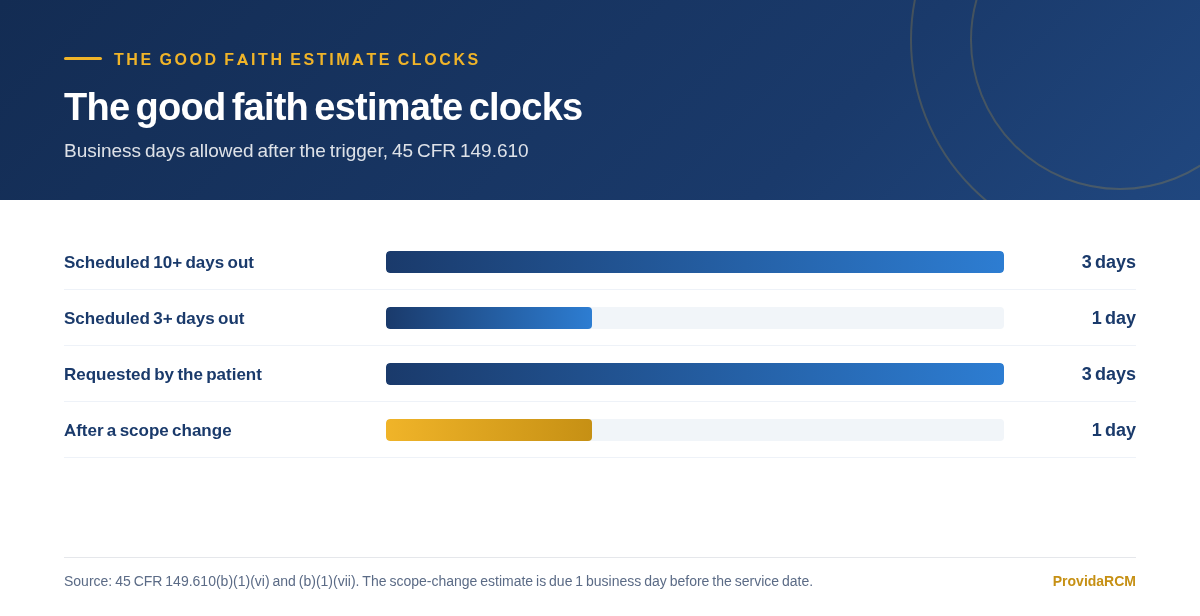
Timing is the part practices miss most, because every deadline runs on business days and the regulation sets five clocks. Two belong to the convening provider’s dealings with co-providers; three belong to the patient.
| Trigger | When the estimate is due | Authority |
|---|---|---|
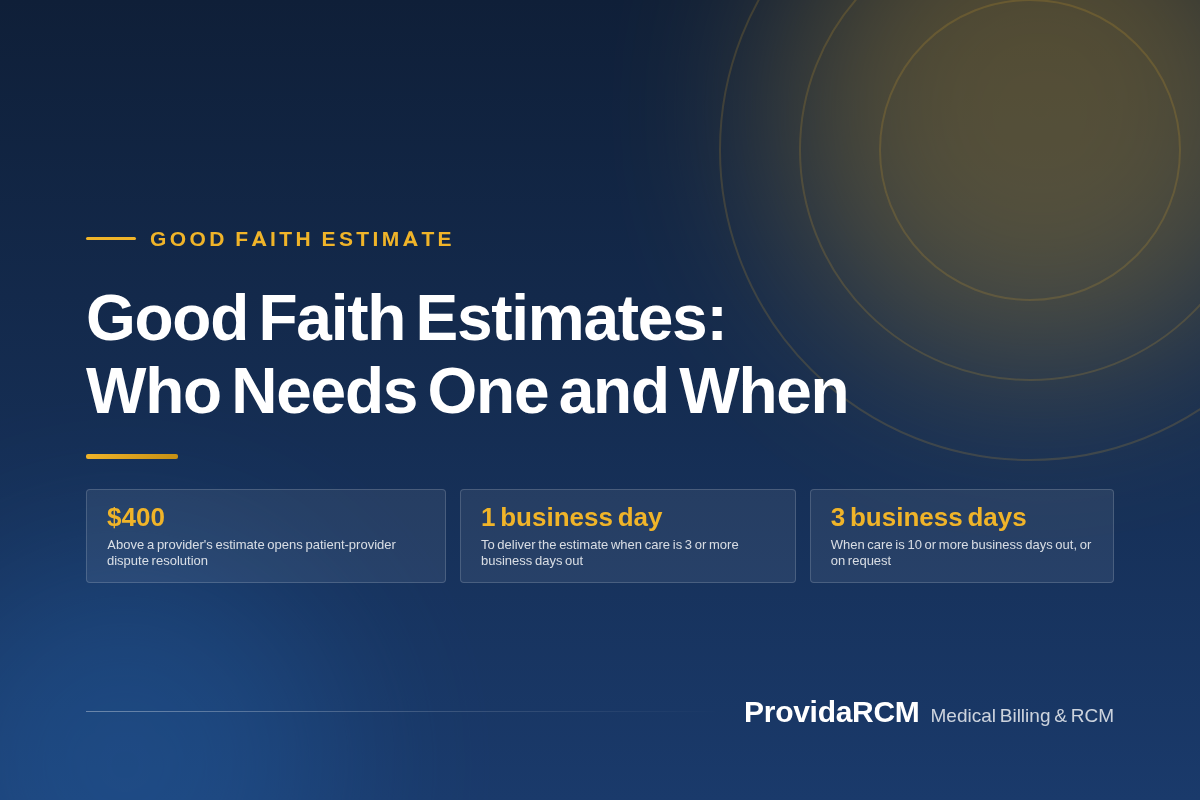
| Scheduled at least 3 business days before service | Not later than 1 business day after the date of scheduling | 149.610(b)(1)(vi)(A) |
| Scheduled at least 10 business days before service | Not later than 3 business days after the date of scheduling | 149.610(b)(1)(vi)(B) |
| Patient asks with nothing scheduled | Not later than 3 business days after the request | 149.610(b)(1)(vi)(C) |
| Convening provider must brief expected co-providers | Contact them within 1 business day of scheduling or the request | 149.610(b)(1)(v) |
| A co-provider is asked for its charges | Reply within 1 business day of the request | 149.610(b)(2)(i) |
| The scope of care changes before the visit | A new estimate no later than 1 business day before service | 149.610(b)(1)(vii) |
Business days allowed for each step
Source: 45 CFR 149.610(b)(1)(v), (b)(1)(vi), (b)(1)(vii) and (b)(2)(i).
A cost question is a request. 149.610(b)(1)(iv) requires a convening provider to treat any discussion or inquiry about the potential costs of items or services under consideration as a request for an estimate. A patient asking what a colonoscopy costs in cash starts the 3-business-day clock with nothing scheduled and no form filled in.
Scope changes restart the estimate. If any party anticipates a change to the charges, items, services, frequency, duration, providers or facilities, a new estimate is due no later than 1 business day before the service. A party swapped in less than 1 business day before the visit inherits the replaced party’s estimate as its own.
What the estimate has to contain
149.610(c)(1) fixes the content, and the disclaimers are part of it. An estimate with accurate charges and no disclaimers is not a compliant estimate, and the missing pieces are the ones a dispute reviewer looks for first.
- Patient name and date of birth
- A plain-language description of the primary item or service, with the scheduled date if there is one
- An itemized list grouped by provider or facility, covering the convening party and every co-provider for the period of care
- Applicable diagnosis codes, expected service codes, and the expected charge for each listed item or service
- Name, National Provider Identifier and Tax Identification Number of every party, plus the state and location where care will be furnished
- A list of items expected to need separate scheduling, with instructions for getting those estimates
Four disclaimers carry real weight. One notes that the provider may recommend additional items that must be scheduled or requested separately and are not in this estimate. A second states that the figures are estimates only and that actual items, services or charges may differ. A third explains the patient’s right to start patient-provider dispute resolution, says where to find out how, and states that doing so will not affect the quality of their care. The fourth states that the estimate is not a contract and does not require the patient to obtain care from anyone named in it.
The estimate is also a record. 149.610(f)(1) makes it part of the patient’s medical record, kept the way other records are kept, and requires the convening provider to hand a copy of any estimate issued within the last 6 years to the patient on request. Retention follows your medical record policy and state law; the 6 years is the look-back window for producing a copy. Index estimates by patient and date, because in a dispute your own estimate is the evidence.
How the estimate may be delivered
149.610(e)(1) requires written form, on paper or electronically, using the method the patient requests, inside the applicable window. An electronic estimate must be delivered so the patient can both save and print it, and the language must be clear to the average uninsured or self-pay individual.
An oral answer is an addition, not a substitute. If the patient asks by phone or in person, the convening provider may give the information orally, but it still has to issue the written estimate. A quote read over the phone and never sent satisfies nothing in the regulation.
Availability is a separate duty. 149.610(b)(1)(iii) requires notice of the availability of estimates to be written clearly, displayed prominently and searchable from a public search engine on the website, posted in the office and on-site where scheduling or cost questions happen, given orally when scheduling, and offered in accessible formats and in the languages spoken by the people scheduling with you.
- Publish the notice as a text page a search engine can read, rather than an image or a PDF behind a login
- Send electronic estimates as a file the patient can save and print, and keep the delivery confirmation
When the bill runs over: patient-provider dispute resolution
The estimate has teeth because of the dispute process at 45 CFR 149.620. Substantially in excess is defined rather than judged: total billed charges from a provider or facility at least $400 more than the total expected charges listed for that same party on the estimate. The comparison is per party, so one provider on an episode can qualify while another does not.
The patient starts it. Under 149.620(c)(1) the individual files an initiation notice with HHS postmarked within 120 calendar days of receiving the initial bill and pays the administrative fee to the selected dispute resolution entity. CMS set that fee at $25, states that the process does not start until it is paid, and says the fee is deducted from what the patient owes if they prevail.
The patient-provider dispute timeline
Source: 45 CFR 149.620(c)(1) and (f)(2)(i)-(ii). The $25 administrative fee is set by CMS guidance.
The provider’s side has two deadlines. After the entity sends its selection notice, the provider has 10 business days to submit the estimate, the bill, and any documentation showing the difference reflects a medically necessary item or service arising from unforeseen circumstances that could not reasonably have been anticipated. The entity then has 30 business days from receiving that information to determine the amount owed.
The rules reward a complete estimate. Where an item was on the estimate and the bill is higher, the amount is the lesser of the billed charge or a median payment from an independent database, never below the expected charge. Where an item was not on the estimate and the provider cannot supply that documentation, the amount determined is $0.
If the parties agree on an amount after the dispute starts and before a determination, the provider must notify the entity within 3 business days and reduce the patient’s bill by at least half the administrative fee paid, which CMS puts at $12.50.
What a good faith estimate is not
It is not a bill. The document is a notification of expected charges, and its required disclaimer says the figures are only an estimate and that actual items, services or charges may differ. What the patient receives after the visit is a separate document.
It is not a guarantee. A provider that acts in good faith with reasonable due diligence and makes an error does not fail to comply solely for that reason, provided it corrects the information as soon as practicable. That protection stops at the point of service, because care furnished before the error is fixed can still be disputed.
It is not the instrument an insured patient receives. The estimate belongs to uninsured and self-pay patients. For patients using coverage, the Act contemplated an advance explanation of benefits, produced by the plan from estimate information the provider transmits, and the interim final rule at 86 FR 55980 records that HHS deferred enforcement of the provider transmission duty until further rulemaking.
| Point | Good faith estimate | Advance explanation of benefits |
|---|---|---|
| Who receives it | The uninsured or self-pay individual | A participant, beneficiary or enrollee using coverage |
| Who produces it | The convening provider or facility | The plan or issuer, from estimate information the provider transmits |
| Legal basis | 45 CFR 149.610 | PHS Act section 2799B-6(2)(A) |
| Status today | Applicable since January 1, 2022 | Provider transmission under deferred enforcement |
The operational fix is smaller than the compliance problem it prevents: add the two coverage questions to the registration script, build the estimate with every required element and disclaimer, and store it where it can be found. We do this inside our out-of-network billing work and alongside the dispute file we assemble when a balance is contested. Practices working through the related payment rules usually start with the qualifying payment amount.
Questions practices ask us about this
Does a good faith estimate apply to Medicare or Medicaid patients?
No. The requirement covers uninsured and self-pay individuals, and the self-pay limb of 45 CFR 149.610(a)(2)(xiii)(B) lists commercial coverage and FEHB plans only. CMS states that providers are generally not required to give good faith estimates to people insured under Medicare, Medicaid or other federal health care programs, because other surprise billing protections apply to those programs.
Is a good faith estimate a bill?
No. It is a written notification of expected charges. The regulation requires a disclaimer saying the figures are only an estimate and that actual items, services or charges may differ, plus a second disclaimer that it is not a contract and does not require the patient to obtain care from anyone named in it. The bill after the visit is a separate document.
What is the deadline for sending a good faith estimate?
It depends on the trigger. Care scheduled at least 3 business days out: due not later than 1 business day after scheduling. Care scheduled at least 10 business days out: due not later than 3 business days after scheduling. A request with nothing scheduled: due within 3 business days of the request.
How far over the estimate can a bill run before the patient can dispute it?
The patient-provider dispute process opens when a provider’s or facility’s total billed charges are at least $400 more than the total expected charges listed for that same party on the estimate. The comparison is made per party, so a facility can qualify on an episode while the surgeon on the same episode does not.
How long does a patient have to file a dispute?
The patient must submit an initiation notice to HHS postmarked within 120 calendar days of receiving the initial bill, and pay a $25 administrative fee. The provider then has 10 business days to submit the estimate, the bill and any unforeseen-circumstances documentation, and the selected dispute resolution entity has 30 business days from receiving that information to decide.
What happens if the estimate was wrong by mistake?
45 CFR 149.610(f)(3) says a provider does not fail to comply solely because, acting in good faith and with reasonable due diligence, it makes an error or omission, provided it corrects the information as soon as practicable. That protection stops at the point of service, because care furnished before the error is fixed leaves the patient free to dispute a bill that runs substantially above the estimate.
Want this fixed in your practice?
We run full-cycle billing, coding, credentialing and denial work for practices across the country. Send us a few months of claims and we will show you where the money is going.
Book a free billing review- eCFR, 45 CFR 149.610, Requirements for provision of good faith estimates of expected charges for uninsured (or self-pay) individuals. ecfr.gov/current/title-45/subtitle-A/subchapter-B/part-149/subpart-F/section-149.610
- eCFR, 45 CFR 149.620, Requirements for the patient-provider dispute resolution process. ecfr.gov/current/title-45/subtitle-A/subchapter-B/part-149/subpart-F/section-149.620
- CMS, Medical bill rights: what the No Surprises Act protects. cms.gov/initiatives/your-patient-rights/medical-bill-rights
- CMS, FAQs about Consolidated Appropriations Act, 2021 implementation: good faith estimates for uninsured (or self-pay) individuals, Part 1. cms.gov/cciio/resources/regulations-and-guidance/downloads/guidance-good-faith-estimates-faq.pdf
- Federal Register, Requirements Related to Surprise Billing; Part II, 86 FR 55980, October 7, 2021. federalregister.gov/documents/2021/10/07/2021-21441/requirements-related-to-surprise-billing-part-ii
- CMS, Dispute a medical bill (patient-provider dispute resolution and the $25 administrative fee). cms.gov/medical-bill-rights/help/dispute-a-bill