Modifier 25 tells Medicare that a same-day visit was significant and separately identifiable from the procedure reported beside it, and the note has to carry that claim on its own. The 2026 NCCI policy manual sets the rule, and the OIG’s May 2025 audit found documentation that failed it.
What modifier 25 attests when it goes on the claim
Modifier 25 goes on an evaluation and management line and tells Medicare that the visit was significant and separately identifiable from the procedure or other service reported on the same date of service. The 2026 NCCI policy manual, Chapter I defines the modifier and the circumstances where it may be used. CMS restates the rule for practices in the Evaluation and Management Services booklet.
The modifier does not raise what the visit pays. It removes a bundle. Without it, a same-day visit usually disappears into the payment for the procedure and the claim pays one line instead of two. With it, both lines stay in play and the visit pays at its own allowed amount.
What it asserts is narrow. The visit was its own service, with its own reason and its own work. What it does not assert is that the patient had a second problem, that the diagnosis changed, or that the procedure was unusual. CMS says plainly that the visit and the minor surgical procedure do not require different diagnoses.
| The claim line | What the modifier asserts | What it never asserts |
|---|---|---|
| E/M line with modifier 25 | The visit was significant and separately identifiable from the service reported the same day | That the patient had a separate diagnosis or a second, unrelated problem |
| Procedure line, unchanged | The procedure was furnished and is reported on its own terms | That the assessment inside the procedure can be billed again as a visit |
| Both lines together | Two services were furnished, each with documentation that stands on its own | That one narrative can carry both lines without saying what differed |
Modifier 25 attaches to the E/M code, and the procedure line goes out unchanged. The visit line carries the exposure, so the note behind it is the part worth getting right.
The same diagnosis is fine. The same documentation is not.
An office visit and an injection for the same condition can both be payable. What the record has to show is two pieces of work, not two diagnoses. NCCI states the rule in one sentence: the E/M service and the minor surgical procedure do not require different diagnoses. MLN006764 repeats it for practices, and the OIG report on eye injections leans on the same section of Chapter I.
The procedure code already owns a certain amount of work. Every procedure with a 000 or 010 day global period carries pre-procedure, intra-procedure and post-procedure work inside its payment, and CMS states that an E/M service cannot be reported for that work. The decision to perform the procedure sits inside the payment too, for new patients and established patients alike.
| Component of the procedure | What it covers | Can the same-day visit count it? |
|---|---|---|
| Pre-procedure assessment | The evaluation that led to the decision to perform the procedure | No. NCCI lists it as inherent in the procedure |
| Intra-procedure work | The work of performing the procedure itself | No. It belongs to the procedure code |
| Post-procedure work | Instructions and immediate aftercare tied to the procedure | No. Recovery care is inside the global period |
| The decision to go ahead | Deciding the procedure was appropriate and performing it | No, even when the patient is new to the practice |
| An unrelated problem addressed that day | A condition that is not the reason for the procedure, with its own findings and plan | Yes, when the note documents that work separately |
NCCI is explicit that the fact a patient is new to the provider or supplier is not sufficient by itself to justify reporting an E/M service on the same date as a minor surgical procedure. A practice that bills a visit on every new-patient injection because the patient is new has built an audit finding into its template.
How the NCCI edit pairs decide whether a modifier can bypass
Medicare’s claim systems run procedure-to-procedure edits. Each one pairs a Column One code with a Column Two code. Report both on the same date and the Column One code pays while the Column Two code denies, unless an NCCI PTP-associated modifier applies and the row allows it. One digit in the file decides whether a row allows anything at all.
| Indicator | What the file is saying | What a practice can do with it |
|---|---|---|
| 0 | NCCI PTP-associated modifiers cannot be used to bypass this edit | Nothing. No modifier opens the pair, and resubmitting it unchanged spends a filing window |
| 1 | PTP-associated modifiers may be used to bypass the edit under appropriate circumstances | Append the right modifier when the record supports the separate service, and keep the note ready |
| 9 | Use of PTP-associated modifiers is not specified; assigned to code pairs whose deletion date equals their effective date | Read the row as an artifact of the file, not as permission |
The modifier set that can open an edit is short and fixed. Chapter I names the global surgery modifiers 24, 25, 57, 58, 78 and 79, the other modifiers 27, 59, 91 and the X{EPSU} family, and the anatomic modifiers such as LT and RT. Modifiers 22, 76 and 77 are not PTP-associated, so none of them will move a bundled pair through.
| Same-day combination | Modifier | Why |
|---|---|---|
| Significant, separately identifiable visit with a procedure that has a 000 or 010 day global period | 25 | The visit is separate from the procedure and from the decision to perform it |
| Visit with a procedure that has no global surgery period, an XXX indicator | 25 | The visit has to be above and beyond the usual pre and post work of the procedure |
| Visit where the decision to perform a major surgical procedure was made | 57 | A major procedure has a 090 day global period, and the decision visit is separately reportable |
| Postoperative visit for a problem unrelated to the surgery | 24 | Unrelated care inside a global period is reported with 24, not 25 |
| The assessment that led to a minor procedure, or any pair whose edit row carries an indicator of 0 | None | That work is inside the procedure’s own payment, and no modifier bypasses an indicator of 0 |
The documentation test a reviewer actually runs
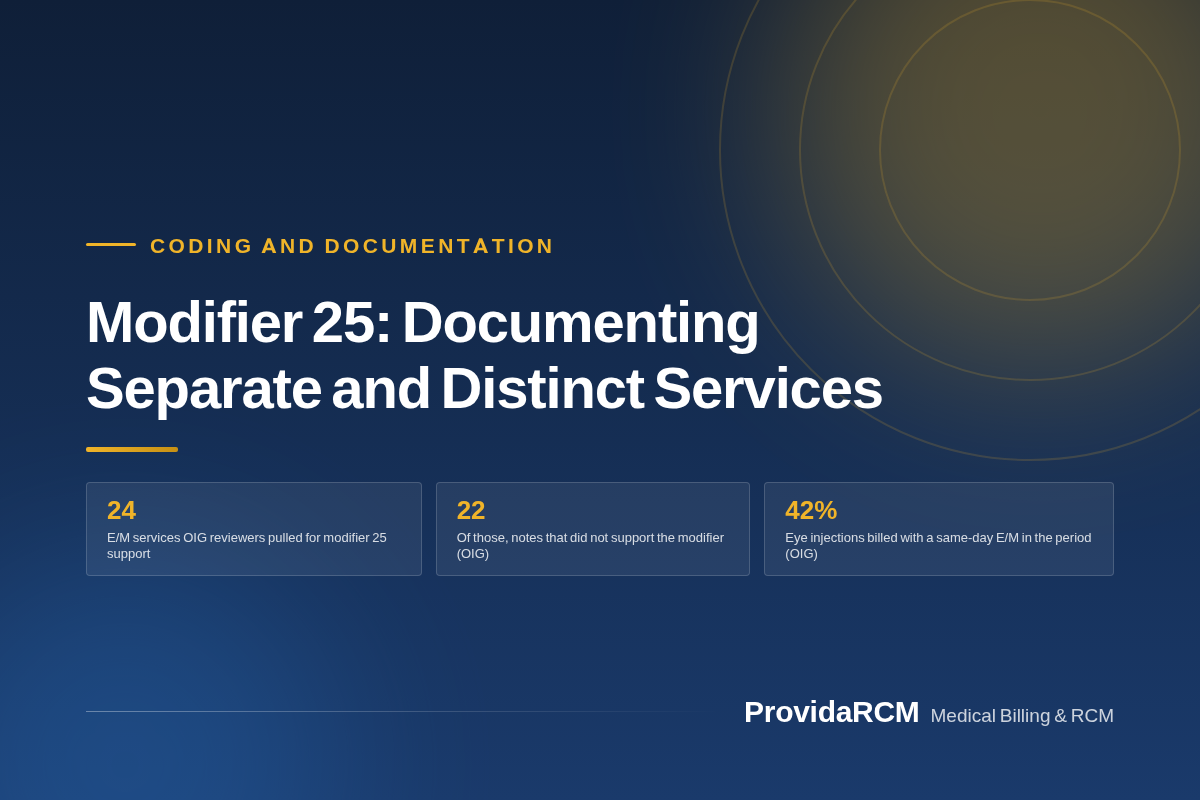
A reviewer opening a same-day claim starts with one question: what in this note is not the procedure? The answer has to be visible in the record. For its May 2025 report, the OIG pulled documentation for 24 E/M services billed with modifier 25 on the same day as an eye injection. Documentation for 22 of the 24 did not support the modifier.
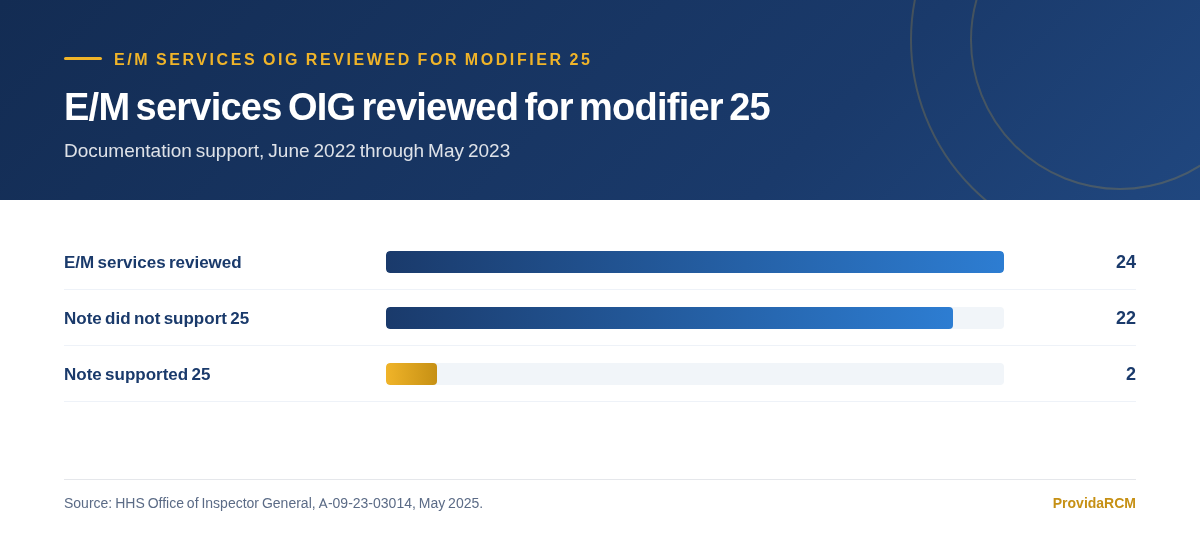
The report describes an E/M service billed on the day of an injection where the note showed the visit existed to decide whether to treat the eye. That decision is inside the procedure’s payment, so the visit should not have carried the modifier. An assessment that ends in a decision to perform the procedure is the most common shape of a failing note.
Two findings, two measurements
Source: HHS Office of Inspector General, A-09-23-03014, May 2025. The 92 percent is 22 of the 24 services sampled.
A reviewer works the same short list every time. The visit has its own presenting problem. It has findings that are not the findings used to justify the procedure. The assessment says what changed, and the plan says what happens next beyond the procedure that was already performed.
| What the note says | Why it fails | What to write instead |
|---|---|---|
| Reviewed retinal findings and imaging, then performed the injection | The findings are the procedure’s own assessment, so the visit has no work of its own | Name the problem being evaluated and the findings that drove the decision |
| Examined both eyes at the time of the injection | CMS uses this exact example: examining the fellow eye at an injection to one eye is not separately identifiable by itself | Show what the fellow-eye exam found and what changed because of it |
| Stable, continue current management, proceed with the procedure | The decision to proceed is inside the procedure’s payment | Leave that sentence to the procedure note and document the visit on its own findings |
| The patient is new, so a visit is billable | NCCI states that new-patient status alone is not enough on its own to support a same-day E/M service | Bill the visit when the documented work supports it, not because of the patient’s status |
| Separate and separately identifiable E/M service performed | A conclusion with no findings behind it is an assertion the reviewer cannot check | Replace the label with the findings, the data reviewed and the decision that followed |
- The visit has a presenting problem named in the note, separate from the procedure’s indication
- The examination and data review support the level of service billed for the visit on their own
- The assessment states what changed or what was newly found that day
- The plan contains something beyond the procedure, such as a medication change or follow-up interval
- Nothing in the visit’s assessment repeats the procedure’s own pre and post work
Why appending it routinely is the failure mode
Modifier 25 is the most audited modifier on the list because it is the easiest to append and the hardest to defend. Chapter I addresses that directly: a modifier may be appended only when the clinical circumstances justify it, and it shall not be appended solely to bypass an edit when they do not.
The OIG’s May 2025 report shows what that costs. In an audit period running from June 2022 through May 2023, Medicare paid $313 million for 3.3 million intravitreal injections and another $124 million for 1.4 million same-day E/M services billed with modifier 25. The OIG found that 42 percent of the injections carried a same-day E/M service with the modifier, and recommended CMS recover up to $123,955,176 for services it determines should not have carried it.
What the audit period cost Medicare
Source: HHS Office of Inspector General, A-09-23-03014, May 2025.
CMS answered the report in the ordinary way. According to the report highlights, CMS concurred with one of the three recommendations and did not indicate concurrence or nonconcurrence with the other two, while describing actions it had taken or planned. The full OIG report lists all three.
The exposure is not ophthalmology-specific. The rule applies wherever a visit is reported with a same-day procedure that carries a 000 or 010 day global period, in any specialty that performs a minor procedure.
When a payer rejects a same-day visit on its modifier, the remittance usually carries CARC 4, which X12 currently words as the procedure code being inconsistent with the modifier used. Older crosswalks still append the phrase or a required modifier is missing, and vendor tables built on them read as current. The same tables often still list CO-15, which X12 deactivated on 1 May 2018.
Writing a note that stands up without padding
The fix is not a longer note. It is a note that keeps what belongs to the visit apart from what belongs to the procedure, in a way a reviewer can point to line by line. Four habits do most of the work.
- 01
Open with the problem
State the medical problem being evaluated and the findings that drove the encounter. If the procedure was the only reason the patient is in the room, there is no visit line and no modifier.
- 02
Let the visit reach its level on its own
Document the history and decision making that support the level billed without counting the procedure’s work toward it. A level that only holds when the procedure is included will not hold on review.
- 03
Say what the visit changed
Name the new or worsening finding, the test reviewed and the management decision that followed. This is the sentence a reviewer looks for, and the one most templates leave out.
- 04
Give the procedure its own paragraph
Indications, consent, technique and aftercare belong with the procedure line. Keep them out of the visit’s assessment, and do not reuse the same sentences on both lines.
Take the procedure out of the note. If what remains still justifies the level of visit billed, the modifier is defensible. If nothing remains, the visit was the procedure’s assessment, and the modifier is the problem rather than the paperwork.
Build the visit template so the assessment field cannot be satisfied by procedure text, and route every same-day visit that carries a modifier through medical coding before the claim goes out rather than after a denial lands. The modifier cheat sheet covers where each bypass modifier applies, and NCCI edits and modifiers explains the indicator column these pairs live in.
When a same-day line does get denied, the CARC on the remittance names the reason and the claim denial codes reference reads it against the payer’s wording. Denials that return on the same code pair month after month are a template problem, and that work belongs in denial management rather than in the appeal queue.
Questions practices ask us about this
Does modifier 25 increase what Medicare pays for the visit?
No. The modifier does not change the fee schedule amount for the E/M service. What it does is prevent the visit from being bundled into the procedure performed the same day, so the visit pays at its own allowed amount rather than nothing. The audit risk sits in the documentation, because the note has to support a visit that was significant and separately identifiable from the procedure and from the decision to perform it.
Do the same-day E/M service and the procedure need different diagnoses?
No. The NCCI policy manual states that the E/M service and the minor surgical procedure do not require different diagnoses, and MLN006764 repeats that for practices. The visit can be related to the same condition as the procedure. What it cannot do is bill work already inside the procedure’s own payment, such as the pre-procedure assessment, the procedure itself or the decision to perform it.
Can modifier 59 be used instead of modifier 25 on an E/M line?
No. NCCI states that modifier 59 should not be appended to an E/M service, and directs practices to modifier 25 to report a separate and distinct E/M service with a non-E/M service on the same date. The X{EPSU} family follows the same logic: those codes narrow the distinct-procedure statement for procedures rather than replacing 25 on a visit line.
What documentation supports a significant and separately identifiable E/M service?
A presenting problem for the visit, findings that are not the findings used to justify the procedure, an assessment that states what changed, and a plan with something in it beyond the procedure. The OIG reviewed documentation for 24 same-day E/M services billed with modifier 25 and found 22 that did not support the modifier, most often because the visit existed to decide whether to perform the procedure.
When is modifier 57 the correct code instead of modifier 25?
Modifier 57 reports the visit where the decision to perform a major surgical procedure was made, which is a procedure with a 090 day global period. Modifier 25 belongs with a procedure that has a 000 or 010 day global period or with a procedure that carries a global surgery indicator of XXX. Other preoperative visits on the same date as a major procedure are inside the procedure’s global payment and are not separately reportable.
Modifier use is a coding habit, not a coder’s opinion
We review same-day visit and procedure pairs, rewrite the note templates behind the worst ones, and handle the appeals when a contractor asks for documentation. Send us a few months of claims with modifier use and we will show you the pairs that carry the exposure.
Book a free coding review- CMS, Medicare NCCI Policy Manual, Chapter I, sections D and E (revision date 1 January 2026). cms.gov/files/document/01-chapter1-ncci-medicare-policy-manual-2026-final.pdf
- CMS MLN006764, Evaluation and Management Services (March 2026). cms.gov/files/document/mln006764-evaluation-management-services.pdf
- HHS Office of Inspector General, A-09-23-03014, Medicare Payments for Same-Day Evaluation and Management Services With Eye Injections (May 2025). oig.hhs.gov/reports/all/2025/medicare-payments-for-evaluation-and-management-services-provided-on-the-same-day-as-eye-injections-were-at-risk-for-noncompliance-with-medicare-requirements
- HHS Office of Inspector General, A-09-23-03014 report highlights (May 2025). oig.hhs.gov/documents/audit/10287/A-09-23-03014-highlights.pdf
- CMS, Medicare NCCI FAQ library (modifier 25 under NCCI). cms.gov/medicare/coding-billing/national-correct-coding-initiative-ncci-edits/medicare-ncci-faq-library
- X12, Claim Adjustment Reason Codes (current list). x12.org/codes/claim-adjustment-reason-codes