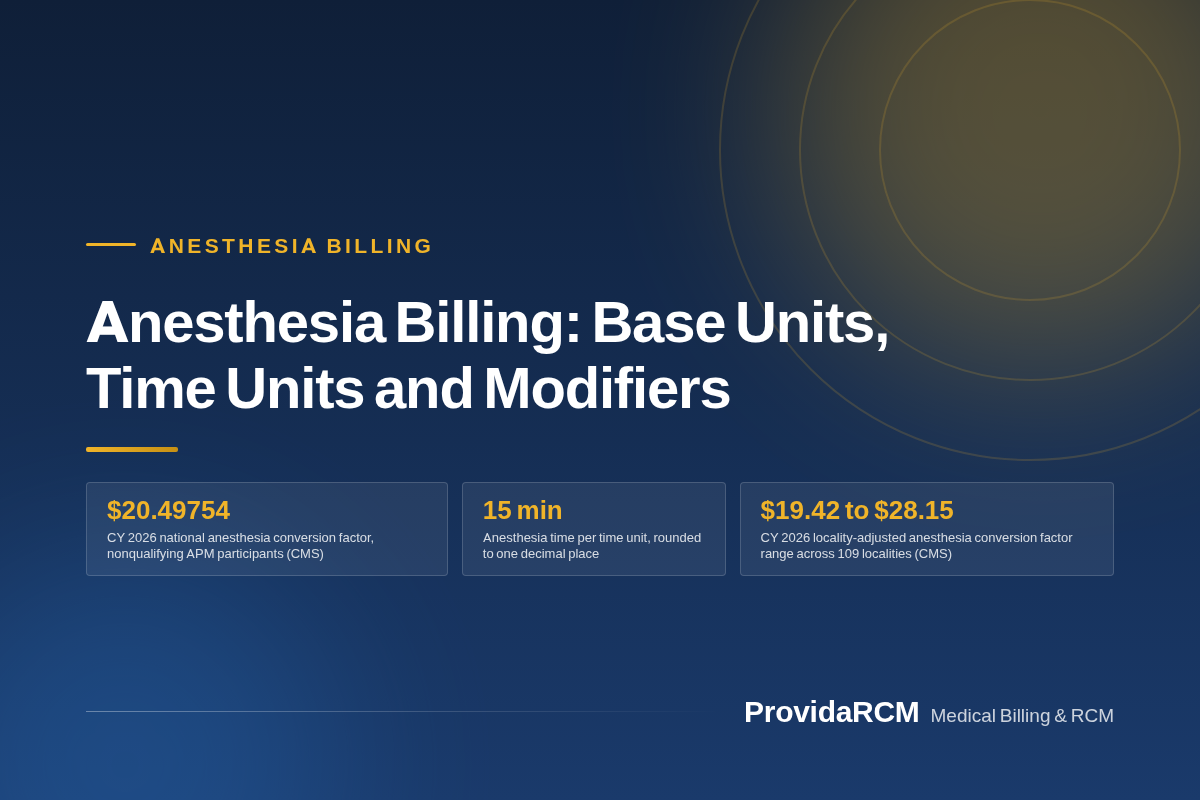
Anesthesia billing is paid on units, not on work RVUs: the base units CMS publishes for the procedure code, one time unit for every 15 minutes of anesthesia time, and a conversion factor that changes every year. Medicare’s national CY 2026 anesthesia conversion factor is $20.49754 for nonqualifying APM participants.
Anesthesia billing runs on three numbers, not an RVU
A fee schedule amount for anesthesia is the sum of allowable base units and time units, multiplied by a conversion factor for the locality. That is the rule in 42 CFR 414.46(b)(1), and it is the entire formula. No work RVU is involved, and no separate payment attaches to the anesthesia record itself. Get any one of the three inputs wrong and the claim is either short or reviewed.
Base units are the fixed value assigned to the procedure code. They cover everything that surrounds anesthesia time: the usual pre-operative and post-operative visits, fluids and blood given as part of anesthesia care, and monitoring services. The regulation defines them that way, which is why a claim cannot be split into separate visit charges on top of the anesthesia code.
| Input | What it represents | Where the number comes from | CY 2026 status |
|---|---|---|---|
| Base units | Fixed units for the procedure code, before any time is added | The CMS base unit file, drawn from the 1988 ASA Relative Value Guide | Unchanged for CY 2026 |
| Time units | Anesthesia minutes divided by 15, rounded to one decimal place | The anesthesia record, reported on the claim in minutes | One unit per 15 minutes |
| Conversion factor | Dollars per unit, adjusted for the payment locality | The Physician Fee Schedule, republished every year | $20.49754 national, nonqualifying APM |
| Modifier units | Extra units for health status, risk, age or unusual circumstances | Nobody. The regulation does not permit them | Not payable |
Anesthesia conversion factor by locality, CY 2026
Source: CMS, 2026 Anesthesia Conversion Factors, locality-adjusted workbook for nonqualifying APM participants, updated 20 November 2025.
The conversion factor is the input that moves. CMS published a national anesthesia conversion factor of $20.3178 in its CY 2025 file and $20.49754 for CY 2026, with $20.599835 for qualifying APM participants under the CY 2026 Physician Fee Schedule final rule. Because the anesthesia factor is built from the work, practice expense and malpractice shares of each area, the same units pay $19.42 in Arkansas and $28.15 in Alaska across the 109 localities in the CY 2026 workbook.
Base units: what CMS publishes and what those units already include
Base units are published by CMS, not by a specialty society, and they are set once. The values in the CMS base unit file are derived from the 1988 American Society of Anesthesiologists Relative Value Guide, with one exception written into the payment rule: anesthesia for cataract and iridectomy surgery is recognized at four units regardless of what the guide says. CMS states on its anesthesia resource page that the base units are unchanged for CY 2026, so the published values are the ones to bill against today.
| Code | The service it covers, in plain terms | Base units | Why it matters |
|---|---|---|---|
| 00100 | Surgery inside the skull | 5 | The benchmark for high-acuity neuro cases |
| 00142 | Lens and cataract surgery | 4 | Fixed at four units by regulation |
| 00790 | Upper abdominal surgery, including laparoscopic | 7 | Two more units than the lower abdomen |
| 00840 | Lower abdominal surgery, including laparoscopic | 6 | Frequently reported alongside a general surgery claim |
| 00910 | Procedures through the urethra, including cystoscopy | 3 | One of the lowest base unit values in the file |
| 01967 | Labor pain relief by epidural or spinal technique | 5 | Rarely paired with a second anesthesia code |
| 01996 | Daily management of a continuous epidural or spinal catheter | No time units | Paid without any time units at all |
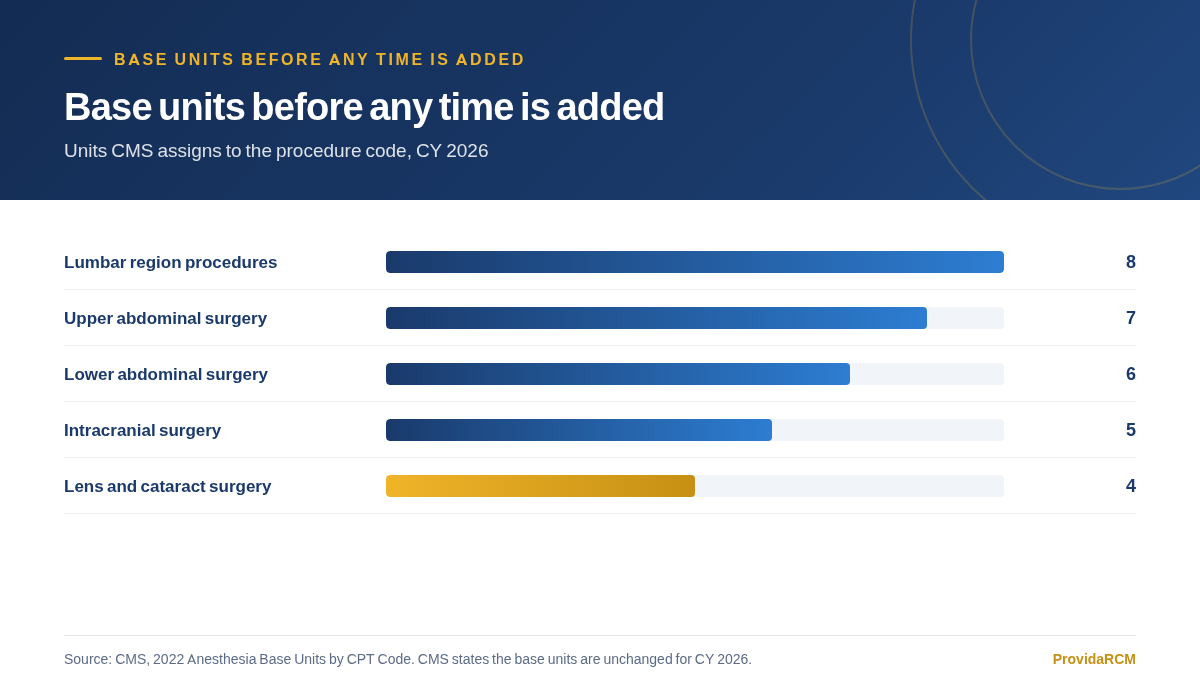
Two things follow from that table. Base units do not scale with how difficult the case turned out to be, so a clinician who wants the record to reflect complexity has to put it in the documentation rather than in the unit count. And Chapter 12 of the Medicare Claims Processing Manual says the MAC does not recognize time units for 01996 at all, which means a practice that adds anesthesia minutes to a daily epidural management line is creating a takeback.
Anesthesia time: when the clock starts, when it stops, how it rounds
Anesthesia time is the period during which an anesthesia practitioner is present with the patient. It starts when that practitioner begins preparing the patient for anesthesia services, and it ends when the practitioner is no longer furnishing anesthesia services, which the regulation ties to the point at which the patient may safely be placed under postoperative care. The manual puts the start in the operating room or an equivalent area.
Two details drive most of the disputes. Anesthesia time is a continuous period, but the practitioner may add blocks of time around an interruption as long as care is continuous on either side of it. And what goes on the claim is actual minutes, which the MAC divides by 15 and rounds to one decimal place. The ratio itself is regulatory: one time unit equals 15 minutes, and fractions of a 15-minute period are recognized as fractions of a unit.
Time units by anesthesia time reported
Source: 42 CFR 414.46(c)(2) and Medicare Claims Processing Manual, Chapter 12, section 50(G).
When an anesthesiologist medically directs a CRNA, the physician reports the same anesthesia time the CRNA reports. A claim pair that starts one clock at 07:42 and the other at 07:51 invites review, because the directed rate is half of the personally performed allowance and a reviewer will recompute both sides from the record.
One more convention belongs here. The anesthesia time on the claim is the time the practitioner was present, not the time the room was in use, not the turnover time, and not the time the patient spent in the holding area before the practitioner arrived. Those minutes are outside the definition however the schedule is written.
Physical status and qualifying circumstances: what they change and what they do not
Physical status modifiers use the P1 through P6 scale to record how sick the patient was before anesthesia began, and they earn their place on every anesthesia record. What they do not do under Medicare is add money. The anesthesia payment rule states plainly that modifier units are not allowed, and it names patient health status, risk, age and unusual circumstances among the things that cannot be billed as extra units.
The qualifying circumstances codes sit in the same bucket. They exist to flag a patient at the extremes of age, deliberate hypothermia or controlled hypotension used as part of the anesthetic, and emergency conditions that make the anesthesia materially harder. Some commercial contracts allow an added unit for one or more of them. Read the contract. The Medicare answer is fixed by regulation and does not vary from one MAC to the next.
| Modifier | What it records | Effect on Medicare units |
|---|---|---|
| P1 and P2 | A healthy patient, or one with mild systemic disease | None. Documented, not paid |
| P3 | A patient with severe systemic disease | None under 42 CFR 414.46(b)(3) |
| P4, P5 and P6 | Disease that is a constant threat to life, a moribund patient, or an organ donor | None, however much the case changes |
| 99100 | A patient at the extremes of age | None |
| 99116 and 99135 | Deliberate hypothermia, or controlled hypotension used as part of the anesthetic | None |
| 99140 | Emergency conditions that increase the difficulty of the anesthesia service | None |
None of that makes the codes optional. A payer reviewing records will look for the physical status, and the anesthesia record is the document that carries it. Coding the status accurately is a clinical documentation duty, separate from the arithmetic of the unit total, and a payment rule should not be allowed to talk a practice out of either one.
The payment modifiers that decide who gets paid and how much
Anesthesia claims settle the payment question with a modifier rather than with units. Chapter 12 of the Medicare Claims Processing Manual lists the set, and the modifier tells the MAC which rate to apply: full, half, or a flat supervision amount. Report the wrong one and the units stop mattering.
| Modifier | Who reports it and when | Rate applied |
|---|---|---|
| AA | The anesthesiologist personally performed the entire service | Full personally performed allowance |
| QK | The physician medically directed two, three or four concurrent cases involving qualified individuals | 50 percent of the personally performed allowance |
| QY | An anesthesiologist medically directed a single CRNA | 50 percent, when the conditions for one case are met |
| AD | The physician medically supervised more than four concurrent procedures | Three base units and no time units |
| QZ | A CRNA furnished the service without medical direction | The nonmedically directed CRNA rate |
| QS | Monitored anesthesia care was provided | Informational. A payment modifier must ride with it |
| GC | A resident performed the service under a teaching physician | Teaching rules apply, plus a payment modifier |
Two of these sit behind most anesthesia denials. The first is reporting AA when the truth is QK: the case involved a CRNA and a physician, and AA claims the physician did the whole thing. The second is the reverse, billing at the directed rate for a case where the physician was not there for the most demanding part of the anesthesia plan. Both are documentation failures before they are coding failures.
Concurrency is counted in procedures, not in Medicare patients. If an anesthesiologist directs three overlapping procedures and two of them belong to commercially insured patients, that is still three concurrent cases for the four-case limit. A practice that counts only Medicare cases will under-report concurrency and bill the wrong rate on the third case.
Medical direction, medical supervision and the 50 percent rule
Direction and supervision are not synonyms in the payment rules, and the difference is money. Medical direction pays 50 percent of what the same service would pay if the physician had performed it alone, a percentage fixed at 50 percent from the CY 1998 fee schedule forward. Medical supervision is what happens above four concurrent cases: the fee schedule amount is built on three base units with no time units attached.
To bill at the directed rate, the physician must satisfy seven conditions for each patient: perform the pre-anesthetic examination and evaluation, prescribe the anesthesia plan, personally participate in the most demanding parts of that plan including induction and emergence, make sure any part he does not perform is done by a qualified individual, monitor the course at frequent intervals, remain physically present and available for emergencies, and provide the indicated post-anesthesia care.
The percentage test that governs all of this is a case count. The physician may direct no more than four anesthesia services concurrently and may not furnish any other services while directing them. Documentation is the physician’s job alone: that he performed the pre-anesthetic exam, provided the post-anesthesia care, and was present for the most demanding procedures, including induction and emergence where applicable.
Here is the arithmetic with dated numbers. Five base units plus 90 minutes of anesthesia time is six time units, so 11 units. Against the national CY 2026 conversion factor for nonqualifying APM participants, $20.49754, that case is $225.47 before the locality adjustment and before any reduction for medical direction. The same case directed would land at half of it.
- Read ten anesthesia claims and confirm the payment modifier matches who was in the room
- Recompute time units from the documented minutes and check the one-decimal rounding
- Confirm the physician documented the pre-anesthetic evaluation and presence at induction
- Scan Medicare claims for extra units added for physical status or qualifying circumstances
- Verify that 01996 lines carry no time units
ProvidaRCM runs medical billing and medical coding for specialty practices, and our 2026 Physician Fee Schedule breakdown covers what else changed in the fee schedule this year. If anesthesia denials are piling up in your work queue, the denial management team can review the last 90 days and show you the pattern.
Questions practices ask us about this
How is anesthesia time converted into billable units?
The MAC divides the actual anesthesia minutes reported on the claim by 15 and rounds the result to one decimal place. That ratio is regulatory: one anesthesia time unit equals 15 minutes, and fractions of a 15-minute period are recognized as fractions of a unit. A 90-minute case is 6.0 time units. The units are then added to the base units for the procedure code, and the total is multiplied by the locality conversion factor.
Does Medicare pay extra units for physical status modifiers?
No. The anesthesia payment rule at 42 CFR 414.46(b)(3) states that modifier units are not allowed, and it lists patient health status, risk, age and unusual circumstances as examples. P1 through P6 still belong on the record because they describe the patient and payers review them, but they do not change the unit total or the payment on a Medicare claim. Some commercial contracts pay differently, so check the contract language.
What is the difference between medical direction and medical supervision?
Medical direction covers two, three or four concurrent anesthesia procedures and pays 50 percent of the personally performed allowance, provided the physician performs and documents the required activities for each case. Medical supervision is the category above four concurrent procedures, and the fee schedule amount is then based on three base units with no time units. The QK modifier reports direction, and the AD modifier reports supervision.
What is the 2026 anesthesia conversion factor?
CMS published a national anesthesia conversion factor of $20.49754 for CY 2026 for physicians who are not qualifying APM participants, and $20.599835 for qualifying APM participants, in its 2026 anesthesia conversion factors workbook updated 20 November 2025. The factor is then adjusted for the locality, so the values in that workbook run from $19.42 in Arkansas to $28.15 in Alaska across 109 localities.
How many concurrent cases can a physician medically direct?
Four. The regulation requires that the physician direct no more than four anesthesia services concurrently and that the physician provide no other services while directing them. Concurrency is counted in procedures, not in Medicare patients, so a case involving a commercially insured patient still counts toward the four. Above four concurrent cases the claim moves to the medically supervised category and the units change.
Where do anesthesia base units come from?
CMS publishes them in its anesthesia base unit file, and the values are derived from the 1988 American Society of Anesthesiologists Relative Value Guide. One rule overrides the guide: cataract and iridectomy anesthesia is recognized at four units. CMS states that the base units are unchanged for CY 2026, so the published values apply, and no payer may substitute a different base unit value for a Medicare claim.
Why does the same anesthesia code pay differently in two states?
The anesthesia conversion factor is adjusted by the geographic practice cost indices, which measure the work, practice expense and malpractice costs of a payment locality. In the CY 2026 workbook the adjusted factor runs from $19.42 in Arkansas to $28.15 in Alaska, a spread of about 45 percent. The base units and the 15-minute time unit are identical everywhere. Only the dollars per unit change.
Want your anesthesia claims rebuilt?
We handle anesthesia and specialty billing end to end, including time unit review and modifier audits. Send us 90 days of claims and we will show you where the units are being lost.
Book a free billing review- CMS, Anesthesiologists Information Center (anesthesia conversion factor and base unit files). cms.gov/anesthesiologists-information-center
- CMS, 2026 Anesthesia Conversion Factors, locality-adjusted workbook (updated 20 November 2025). cms.gov/files/zip/2026-anesthesia-conversion-factors.zip
- CMS, 2022 Anesthesia Base Units by CPT Code (the base units CMS states are unchanged for CY 2026). cms.gov/files/zip/2022-anesthesia-base-units-cpt-code.zip
- CMS, Medicare Claims Processing Manual, Chapter 12, section 50, Payment for Anesthesiology Services. cms.gov/regulations-and-guidance/guidance/manuals/downloads/clm104c12.pdf
- 42 CFR 414.46, Additional rules for payment of anesthesia services (eCFR). ecfr.gov/current/title-42/chapter-IV/subchapter-B/part-414/subpart-B/section-414.46
- 42 CFR 415.110, Conditions for payment: Medically directed anesthesia services (eCFR). ecfr.gov/current/title-42/chapter-IV/subchapter-B/part-415/subpart-B/section-415.110
- CMS, CY 2026 Medicare Physician Fee Schedule final rule fact sheet (CMS-1832-F). cms.gov/newsroom/fact-sheets/calendar-year-cy-2026-medicare-physician-fee-schedule-final-rule-cms-1832-f