Urgent care billing turns on one field before any code is chosen: the place of service. A freestanding centre bills the urgent care facility code, a centre that has not established the facility distinction bills as an office, and a hospital-owned site bills as a hospital outpatient department. That field decides the rate.
Urgent care billing starts with a place of service code
Every professional claim carries a two-digit place of service code in box 24B of the CMS-1500. CMS defines place of service 20 as an urgent care facility: a location, distinct from a hospital emergency room, an office or a clinic, whose purpose is to diagnose and treat illness or injury for unscheduled, ambulatory patients seeking immediate medical attention.
The code says where the care happened, not what happened in the room. Medicare pays a physician service at the non-facility rate in some settings and the facility rate in others, and the place of service code decides which one applies (Medicare Claims Processing Manual, Chapter 12).
| Code | Setting | What it tells the payer | Rate Medicare pays |
|---|---|---|---|
| 11 | Office | A physician office visit. The practice carries its own overhead | Non-facility (higher) |
| 20 | Urgent Care Facility | Unscheduled, ambulatory care at a location distinct from an office, a clinic or an emergency room | Non-facility (higher) |
| 19 | Off Campus-Outpatient Hospital | A hospital provider-based department located away from the main campus | Facility (lower) |
| 22 | On Campus-Outpatient Hospital | A hospital department on the hospital main campus | Facility (lower) |
| 23 | Emergency Room – Hospital | A hospital emergency department | Facility (lower) |
Medicare 2026 payment for three visit levels, office rate
Source: CMS Medicare Physician Fee Schedule, CY 2026. National amounts before geographic adjustment.
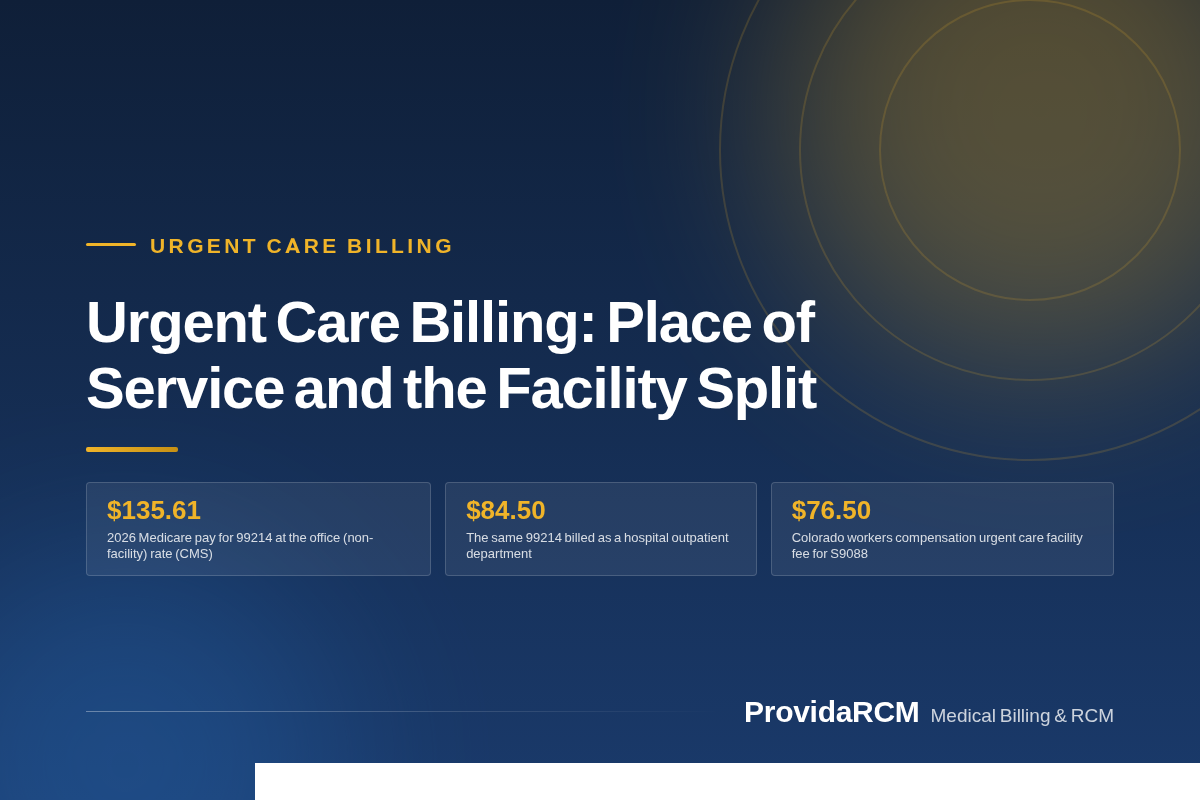
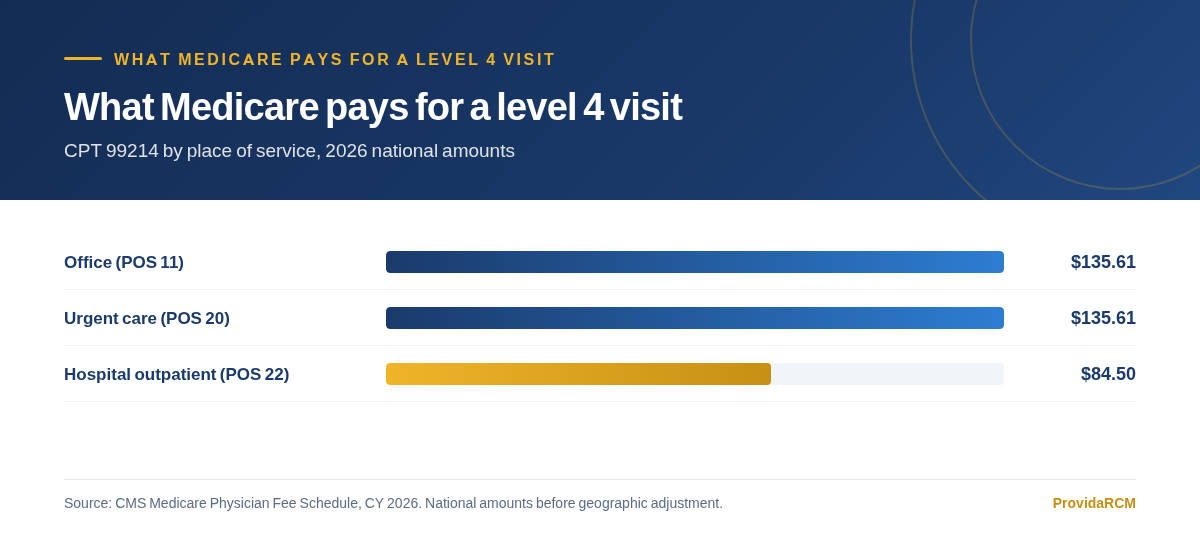
The two columns are far enough apart to matter. In 2026 a level 4 established-patient visit (99214) pays $135.61 nationally at the non-facility rate and $84.50 at the facility rate, $51.11 on one ordinary claim. The work RVUs are identical in both settings. The entire movement sits in practice expense, which covers rent, staff, supplies and equipment.
What decides which place of service a centre may use
A centre does not pick its place of service from a menu. Three things have to line up: state licensure, Medicare and payer enrolment, and how the payer has the centre set up in its own system. Get one wrong and the code will not match the setting the payer holds.
State licensure comes first in states that license urgent care. Maine created an urgent care facility licence in 2025, with standards taking effect on 1 July 2026, and it excludes a facility that is part of a hospital and the private office of a physician in group practice (Title 22, section 1812-M). Massachusetts licenses urgent care centres under its own clinic rules.
Enrolment is the second step. A clinic or group practice enrols with Medicare on the CMS-855B. A hospital-owned site that intends to bill a facility fee enrols as a hospital department on the CMS-855A and has to meet the provider-based criteria at 42 CFR 413.65 for that location (how payer enrolment works). The enrolment fixes which place of service and claim form the site may use.
The third step is how the payer treats the centre. A payer can credential a walk-in centre as a physician office and require place of service 11 on every claim, even though the building runs like an urgent care centre. That is why a centre that has not established the facility distinction bills the office way. It is not a preference. The claim has to match the setting the payer has on file.
A payer that holds the centre as an office will reject claims filed with the urgent care facility code. Confirm the setting each payer has on file before the first claim, and again whenever a contract renews or a new location opens.
| Requirement | Where it is documented | What it changes |
|---|---|---|
| State licence or exemption | The state licensing statute or exemption | Whether the payer will recognise the centre as a facility |
| Medicare enrolment as a clinic or group | CMS-855B, recorded in PECOS | The specialty and setting on record |
| Provider-based status for a hospital site | 42 CFR 413.65 criteria and CMS-855A | Whether the site bills 19 or 22 and files a facility claim |
| Payer credentialing as urgent care | The participation agreement and the payer place of service table | Which place of service code the payer will accept |
The professional and facility split
An independently owned urgent care centre submits one professional claim. The E/M code carries the practice-expense component, because the practice pays the rent, the staff and the supplies. That is why place of service 20 prices at the same non-facility rate as an office.
A hospital-owned centre can produce two claims. The treating practitioner files a professional claim at the facility rate, and the hospital files an institutional claim for the room, the equipment and the support staff.
A freestanding centre with no hospital parent has no institutional claim to file. If it wants anything like a facility fee, it has to come from the payer contract, usually as a HCPCS add-on such as S9088, reported alongside the E/M code. Whether that add-on pays is entirely payer-specific.
Blue Cross and Blue Shield of Louisiana recognises urgent care centres as establishments similar to physician offices and states that it does not reimburse separately for a facility fee or a treatment room fee. It treats S9088 as informational only and does not pay it (Professional Provider Office Manual, Section 538).
The same three codes at the hospital facility rate
Source: CMS Medicare Physician Fee Schedule, CY 2026. National amounts before geographic adjustment.
Filing place of service 20 does not create a right to a facility fee. The centre has to be licensed or exempt the way the payer requires, enrolled the way the payer requires, and the contract has to name the add-on and its rate. Without all three, the fee is unbillable or denied, and billing the patient for it can breach the participation agreement.
| Payer or program | Facility fee at urgent care? | What it requires | Document |
|---|---|---|---|
| Blue Cross and Blue Shield of Louisiana | No | Contracts with the centre as an urgent care establishment; treats S9088 as informational only | Professional Provider Office Manual, Section 538 |
| Ambetter Health (Pennsylvania) | Only with the correct place of service | S9083 and S9088 payable only when billed with POS 20, from 1 August 2026 | Ambetter Health Pennsylvania provider update |
| Colorado workers compensation | Yes, if the facility is accredited | S9088 at $76.50; the facility must be accredited or certified by the Urgent Care Association or the Joint Commission | 7 CCR 1101-3-18-5 |
The after-hours code: paid, bundled or refused
Two codes mark the hour rather than the service. CPT 99050 reports care when the office is normally closed. CPT 99051 reports care during regularly scheduled evening, weekend or holiday hours. Both are reported alongside the E/M service, and both mean nothing on their own. What they pay depends on the payer.
Medicare bundles both. CMS assigns the codes status B, which means payment is always bundled into the other services on the claim and no separate amount is paid. A modifier does not override it. Several commercial payers pay anyway, and the condition each attaches is the part centres miss.
| Payer | Separate payment for 99050 or 99051? | Conditions | Document |
|---|---|---|---|
| Medicare | No | Both codes carry status B; payment is bundled into the other service on the claim | CMS, as restated in payer reimbursement policies |
| UnitedHealthcare (Commercial and Individual Exchange) | Yes, for participating primary care providers | Only in listed non-facility settings, including office 11, independent clinic 49 and rural health clinic 72 | After Hours and Weekend Care Policy 2026R0044A |
| Blue Cross and Blue Shield of North Carolina | Yes | Reimbursed for any place of service other than urgent care or the emergency department | Status Codes Reimbursement Policy update, January 2022 |
| EmblemHealth (Commercial) | Yes, for 99050 | Place of service 11 only, billed with an eligible E/M code | After Hours and Weekend Care policy |
Read the Blue Cross NC rule closely. That payer reimburses the after-hours code in every setting except urgent care and the emergency department. A centre that extends its hours and bills 99051 at place of service 20 may be handing that payer a reason to deny, because the exclusion lands on the setting the code was designed around.
UnitedHealthcare pays both codes for listed primary care specialties in non-facility settings. EmblemHealth pays 99050 in place of service 11 only. Blue Cross NC excludes urgent care altogether. One payer is not the market standard.
Choosing the E/M level, and the visit that turns into an emergency
Urgent care uses the office and outpatient E/M family, 99202 to 99215, at the urgent care place of service. The level is chosen the way it is chosen in a physician office: by medical decision making or by total time on the date of the encounter, whichever the record supports better (how E/M levels are picked).
The ED visit codes 99281 to 99285 are not interchangeable with those. CPT defines them for the emergency department, and payers edit for it. Molina Healthcare states that codes 99281 to 99285 will be denied when reported with any place of service other than 23 (Molina Healthcare). A centre at place of service 20 that reaches for an ED code is asking for a denial.
| Setting | E/M family | Place of service | Level set by |
|---|---|---|---|
| Freestanding urgent care centre | 99202 to 99215 | 20 | Medical decision making or total time |
| Physician office | 99202 to 99215 | 11 | Medical decision making or total time |
| Hospital emergency department | 99281 to 99285 | 23 | Medical decision making |
That matters when a walk-in turns out to be an emergency. If the centre can stabilise the patient, the encounter is still an urgent care visit and still uses office and outpatient E/M at place of service 20. The level usually rises, because the medical decision making did.
If the centre cannot stabilise the patient, the transfer is the next event, and the record has to carry it: the findings, the decision to transfer, the receiving facility and its acceptance. A hospital-owned centre may also carry EMTALA obligations, since EMTALA attaches to Medicare-participating hospitals with a dedicated emergency department (CMS, EMTALA). An independently owned centre is generally outside EMTALA.
- Record the findings that made the case an emergency, and the final diagnosis that followed
- Record the transfer decision, the destination and the accepting facility
- Keep the encounter on office and outpatient E/M at place of service 20
Why payer variance decides urgent care billing economics
Two centres with the same licence, the same staff and the same visit mix can collect very different amounts, because the payers in their contracts treat urgent care differently. The variance sits in three places: whether the payer recognises urgent care as a setting, which rate schedule the payer applies, and whether the payer pays an urgent care add-on.
Recognition is the first question. A payer with a distinct urgent care designation may hold the centre to a higher rate schedule than its office schedule. A payer that never created the designation treats the centre as a physician office, applies the office schedule, and usually requires place of service 11.
When a payer treats the centre as a physician office, the claim still pays, on the office schedule with no add-on and no designation. For a centre built around extended hours and walk-in staffing, that is the difference between a service line that funds itself and one that does not.
The contracting conversation is where the numbers move. Ask four questions: does this payer have an urgent care designation at all; which place of service code will it accept; what rate schedule applies at that setting; and will it pay an urgent care add-on such as S9088 or S9083. Get the answers into the participation agreement and the payer provider manual, because the manual is what a claims editor reads.
Three of those answers change the arithmetic before any coding does. A centre billing place of service 11 against a contract that recognises place of service 20 loses the designation on every visit. A centre billing an add-on the payer bundles is building denials into the worklist. A centre that never raised the designation at renewal is still on the office schedule it signed years ago.
Questions practices ask us about this
Can an urgent care centre bill a facility fee?
It depends on three things: state licensure or exemption, how the centre is enrolled and credentialed, and what the payer contract says. Blue Cross and Blue Shield of Louisiana states it does not reimburse a separate facility fee at urgent care and treats S9088 as informational. Ambetter Health in Pennsylvania pays S9083 and S9088 only with place of service 20. Colorado workers compensation pays S9088 at $76.50 only when the facility is accredited.
What place of service code does an urgent care centre use?
A freestanding centre licensed and credentialed as urgent care uses place of service 20. A centre the payer has set up as a physician office uses place of service 11, regardless of how it operates. A hospital-owned provider-based department uses place of service 19 or 22 and files a facility claim alongside the professional claim.
Does Medicare pay a separate facility fee at an urgent care centre?
No. Medicare pays the professional claim at the non-facility rate when place of service 20 is reported, and that rate already includes the practice-expense component. A freestanding centre has no institutional claim to submit, so there is no separate facility fee under Medicare. Any facility fee has to come from a commercial or workers compensation contract.
Why was our 99051 after-hours claim denied?
Medicare bundles 99050 and 99051 into the other service on the claim, and some payers follow that. Others pay under conditions. UnitedHealthcare pays both to participating primary care providers in listed non-facility settings. Blue Cross and Blue Shield of North Carolina pays them everywhere except urgent care and the emergency department. EmblemHealth pays 99050 in place of service 11 only.
Can an urgent care centre bill emergency department codes 99281 to 99285?
No. CPT defines those codes for the emergency department, and payers edit for it. Molina Healthcare states that codes 99281 to 99285 will be denied when reported with any place of service other than 23. An urgent care visit under place of service 20 uses the office and outpatient family, 99202 to 99215, leveled by medical decision making or total time.
What happens when a patient is stabilised and transferred?
The urgent care encounter remains an office and outpatient E/M service at place of service 20, usually at a higher level because the medical decision making rose. The record has to carry the findings, the transfer decision and the accepting facility. The receiving hospital files its own emergency department claim.
How do we find out which place of service a payer wants?
Check three documents together: the participation agreement, the payer provider manual, and the provider enrolment record that shows how the payer has the site classified. The manual is what a claims editor reads, and the agreement is what you can hold the payer to.
Running urgent care claims and not sure which place of service each payer wants?
We run billing, coding and payer contracting support for urgent care centres, including place of service mapping and facility add-on billing. Send us a few months of claims and we will show you where the setting is costing you money.
See urgent care billing services- CMS, Place of Service Code Set. cms.gov/medicare/coding-billing/place-of-service-codes/code-sets
- CMS, Medicare Claims Processing Manual, Chapter 12. go.cms.gov/manual-physicians-nonphysician-practitioners
- CMS, CY 2026 Physician Fee Schedule final rule fact sheet (CMS-1832-F). cms.gov/newsroom/fact-sheets/calendar-year-cy-2026-medicare-physician-fee-schedule-final-rule-cms-1832-f
- CMS, Emergency Medical Treatment and Labor Act (EMTALA). cms.gov/medicare/regulations-guidance/legislation/emergency-medical-treatment-labor-act
- Blue Cross and Blue Shield of Louisiana, Professional Provider Office Manual, Section 538. providers.lablue.com/-/media/Files/Providers/Professional%20Provider%20Office%20Manual/Section%20538%20Billing%20Guidelines%20Urgent%20Care%20Centers%20pdf.pdf
- UnitedHealthcare Commercial and Individual Exchange, After Hours and Weekend Care Policy. uhcprovider.com/content/dam/provider/docs/public/policies/comm-reimbursement/COMM-After-Hours-Weekend-Care-Policy.pdf
- Blue Cross and Blue Shield of North Carolina, Status Codes Reimbursement Policy update, 2022. bcbsnc.com/providers/provider-news/2022/status-codes-reimbursement-policy-update-codes-99050-and-99051
- EmblemHealth, After Hours and Weekend Care reimbursement policy (Commercial). emblemhealth.com/content/dam/emblemhealth/pdfs/provider/reimbursement-policies/after-hours-reimbursement-policy-emblemhealth.pdf
- Molina Healthcare, Emergency Service E&M Codes and Place of Service 23. molinamarketplace.com/-/media/Molina/PublicWebsite/PDF/Providers/common/PIA-Payment-Policies/Molina-PI-Policy-Website/508-Approved-PDF/E/Emergency-EM-Codes-and-Place-of-Service-23.ashx
- Colorado, 7 CCR 1101-3-18-5 Facility Fees. law.cornell.edu/regulations/colorado/7-CCR-1101-3-18-5
- Maine, Title 22 section 1812-M, Urgent care facility. legislature.maine.gov/statutes/22/title22sec1812-M-1.html
- Ambetter Health Pennsylvania, Procedure Codes S9083 and S9088 update. pahealthwellness.com/content/dam/centene/Pennsylvania/pdfs/Procedure%20Codes%20S9083%20S9088%20Update%20Eff%208.1.2026.pdf