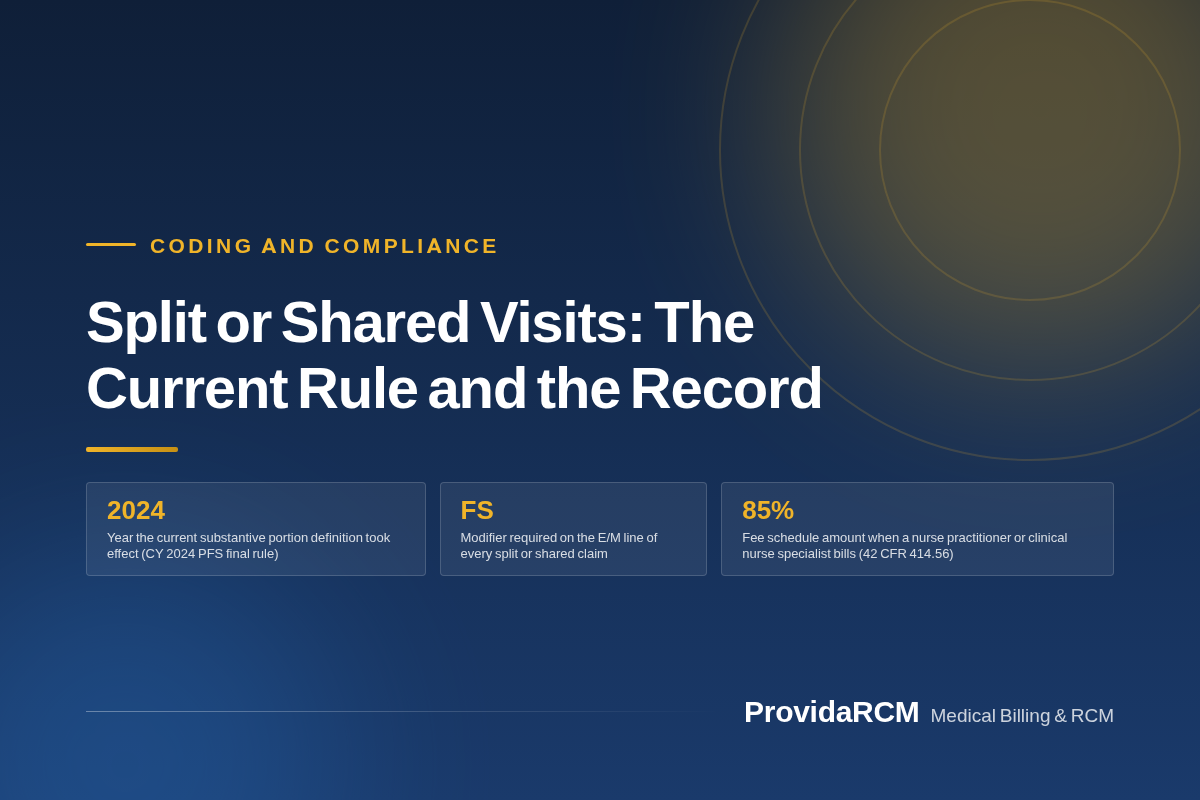
Split shared visits are decided by who performed the substantive portion of the encounter: the practitioner who spent more than half of the total time, or the one who performed the substantive part of the medical decision making. Under the 2024 rule only those two measures count, and history, the exam and a countersignature are none of them.
What a split or shared visit is under the 2024 rule
A split or shared visit is an evaluation and management visit in a facility setting that a physician and a nonphysician practitioner in the same group each performed in part, such that either of them could have billed the service had they furnished it alone. 42 CFR 415.140 states it that way and adds the condition that decides everything: Medicare pays the practitioner who performed the substantive portion.
The version in force today comes from the CY 2024 Physician Fee Schedule final rule, published at 88 FR 78818 on November 16, 2023 and effective for services on or after January 1, 2024. That rule amended 42 CFR 415.140 at 88 FR 79539 and produced Change Request 13592, which revised Section 30.6.18 of the Medicare Claims Processing Manual, Chapter 12.
| Period | What could establish the substantive portion | Set by |
|---|---|---|
| Through 2021 | All or some portion of the history, the exam, or the medical decision making, with both practitioners seeing the patient on the same date | Medicare Claims Processing Manual, Chapter 12, Section 30.6.1.H, since removed |
| 2022 and 2023 | A medically appropriate history, the exam, or the MDM performed in its entirety, or more than half of the total time | CY 2022 Physician Fee Schedule final rule (86 FR 65682) |
| 2024 onward | More than half of the total time, or a substantive part of the MDM per the CPT guidelines | CY 2024 Physician Fee Schedule final rule (88 FR 78818), amending 42 CFR 415.140 |
Setting is the condition practices miss. Facility setting here means an institutional setting where payment for services incident to a physician’s or practitioner’s professional services is prohibited under 42 CFR 410.26(b)(1), which puts the physician office outside the rule. The 2024 MLN article states that office visits and nursing facility visits are not billable as split or shared services.
MAC summaries of the same manual section describe skilled nursing facility visits as billable when the visit is not one the regulations require a physician to perform in its entirety, which does not read the same way as that MLN note. Confirm the code and place of service on your MAC’s page before billing an SNF visit this way.
The substantive portion: total time or medical decision making
Two measures decide which practitioner bills. The first is time: whoever spent more than half of the total time spent by both practitioners performing the visit. The second is medical decision making: whoever performed a substantive part of the MDM as the 2024 CPT guidelines define it. Critical care and prolonged services allow only the time measure.
MDM is substantive when the practitioner made or approved the management plan for the number and complexity of problems addressed at the encounter and took responsibility for that plan. CPT treats that act as meeting two of the three elements used to select a level on MDM. Reviewing someone else’s note, or co-signing it, meets none of them.
How many measures CMS allowed
Source: CMS MLN Matters MM13592 and Medicare Claims Processing Manual, Chapter 12, Section 30.6.18; transitional definition for services furnished in 2022 and 2023.
History and the exam came off the list on January 1, 2024, and this is where most circulating material is now wrong. For services furnished in 2022 and 2023, the substantive portion could be a medically appropriate history, the exam, or the MDM performed in its entirety, or more than half of the total time. A note that leans on a history, an exam or the senior practitioner’s countersignature to justify who billed no longer answers the question.
Two measures, for services on or after January 1, 2024: more than half of the total time, or a substantive part of the medical decision making. Neither one is a signature on another practitioner’s note.
How split shared visits count the time when both contributed
Time here is not wall clock time, and it is not each practitioner’s time counted separately. The distinct time each practitioner spent is summed to produce the total, and no minute counts twice. When the two are with the patient together, or discussing the case together, only one of them may count that time.
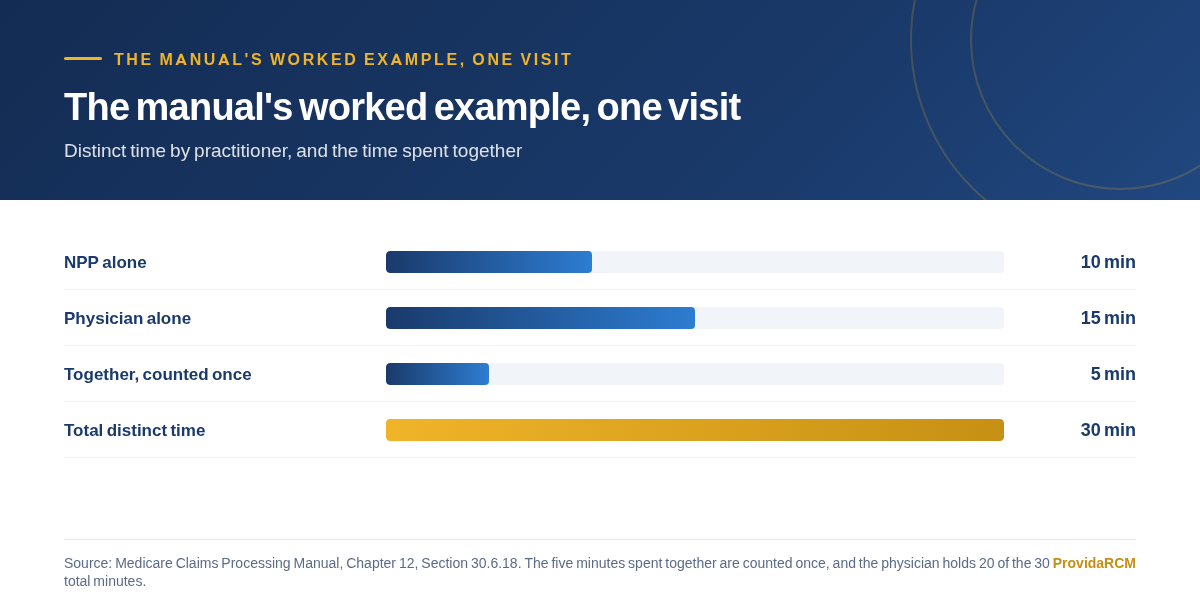
| What happened | Minutes | Counted toward total time |
|---|---|---|
| NPP alone with the patient | 10 | 10 |
| Physician alone with the patient | 15 | 15 |
| Both together, discussing the plan | 5 | 5, at the physician’s credit |
| Total distinct time | 30 | 30, of which the physician holds 20 |
The activities that count toward total time come from the CPT guidelines, and they count whether or not the contact with the patient is face to face:
- Preparing to see the patient, including review of tests
- Obtaining or reviewing a separately obtained history
- Performing a medically appropriate examination or evaluation
- Counseling and educating the patient, family or caregiver
- Ordering medications, tests or procedures
- Documenting clinical information in the record
Services reported separately, travel, and teaching that is general rather than tied to a specific patient’s management. A review that finds any of the three inside the total can restate who performed the substantive portion.
One of the two practitioners has to see the patient in person, and it does not have to be the one who bills. The substantive portion may be furnished entirely without direct patient contact, because what decides it is the proportion of total time rather than the contact.
Prolonged services have their own arithmetic. Once the practitioners reach the threshold for a prolonged services add-on, their time is combined, and whoever holds more than half of that combined total reports the primary service and the add-on code.
The modifier, the NPI and what the claim looks like
Every split or shared E/M claim carries modifier FS on the E/M code. The claim goes out under the national provider identifier of the practitioner who performed the substantive portion, and the record has to show that practitioner signing and dating the note. Paragraph (b)(3) of 42 CFR 415.140 requires the modifier, and your MAC publishes the code set that defines it.
What the same facility visit pays
Sources: 42 CFR 414.56(c) for the nurse practitioner and clinical nurse specialist amount, and the physician fee schedule amount for the same visit.
Payment follows the number on the claim. A physician who bills receives 100 percent of the fee schedule amount. A nurse practitioner or clinical nurse specialist who bills receives at most 85 percent under 42 CFR 414.56(c). On a $200 visit the spread is $30, which is why the substantive portion is a payment question rather than a paperwork question.
Critical care uses the same modifier on different codes. The billing practitioner reports 99291 and any add-on 99292 minutes for the date, with FS appended to the critical care codes. Modifier 52 is not a workaround for a partial visit, because Medicare does not pay for partial E/M visits.
None of this binds a commercial payer. 42 CFR 415.140 governs Medicare payment, while Medicare Advantage plans and commercial contracts set their own requirements for a visit two clinicians share, and some do not recognize the framework at all. Read the contract before applying a Medicare workflow to a commercial claim.
What the record has to contain, and the attestation behind it
Paragraph (b)(2) of the regulation sets two documentation requirements. The record must identify the physician and the nonphysician practitioner who performed the visit, and the individual who performed the substantive portion, and therefore bills, must sign and date the record.
- Both practitioners named in the note for the date of service
- The billing practitioner named as the one who performed the substantive portion
- The measure stated in words: total time, or medical decision making
- Distinct time recorded by each practitioner, when the visit is time based
- Signature and date of the billing practitioner on the record
The attestation is the sentence a reviewer looks for. The billing practitioner states which measure established the substantive portion: that they spent more than half of the total time, or that they made or approved the management plan and take responsibility for it.
A co-signed note is not an attestation. Two signatures with no statement of who performed the substantive portion do not establish the billing NPI, and the claim rests on a fact the record does not contain. Each practitioner should document the portion they furnished and the distinct time they spent, and both should sign.
Split or shared is not incident to, and not locum tenens
Three arrangements can put a second practitioner’s work on a claim, and they do not share rules. Incident to billing is the office rule: a practitioner furnishes part of the physician’s plan of care under the physician’s direct supervision, and the claim goes out under the physician’s number. Split or shared billing is the facility rule. Locum tenens is a third thing, and it is about an absence.
| Point of comparison | Split or shared visit | Incident to service | Locum tenens or reciprocal billing |
|---|---|---|---|
| Setting | Facility: hospital, emergency department, hospital outpatient, and SNF visits not required to be physician only | The office or clinic | Not tied to a setting |
| Who furnished the care | A physician and an NPP in the same group, each performing part of one visit | Auxiliary personnel, often an NPP, under the physician’s plan of care | A substitute physician covering the absent physician’s patients |
| Who bills Medicare | The practitioner who performed the substantive portion, under their own NPI | The physician, under the physician’s NPI | The regular physician, under the regular physician’s NPI |
| Medicare payment | 100 percent if the physician bills; 85 percent for a nurse practitioner or clinical nurse specialist who bills | 100 percent of the fee schedule amount | 100 percent of the regular physician’s fee schedule amount, with the practice paying the substitute |
| Claim identifier | Modifier FS on the E/M code | No modifier specific to the arrangement; the physician’s NPI carries it | Modifier Q6 on a fee-for-time arrangement, modifier Q5 on a reciprocal one |
| Limit | No time limit; the record must support the substantive portion per date of service | The physician must have initiated the course of treatment and stay actively involved | 60 continuous days per substitute physician |
Locum tenens and reciprocal billing cover the physician who is away. A substitute physician treats the absent physician’s patients, the practice bills under the regular physician’s number, and the claim carries modifier Q6 when the practice compensates the substitute on a fee-for-time basis, or modifier Q5 in a reciprocal arrangement where nothing passes between the two physicians. Chapter 1 of the claims processing manual limits the continuous period to 60 days per substitute.
The costly error is a modifier that disagrees with the setting. FS on an office visit describes a service the rule does not cover, and incident to billing in a hospital outpatient department reaches for a framework the regulation prohibits there. A MAC edit reads place of service and modifier together, and the claim has to survive that reading.
What an auditor tests
A medical review of a split or shared visit usually begins with the modifier and the place of service, because those two fields narrow the population before anyone opens a note. Five questions do most of the work from there.
- Was the place of service a facility? FS on an office visit falls outside 42 CFR 415.140.
- Were the two practitioners in the same group, and could either have billed alone?
- Does the record name both practitioners and who performed the substantive portion?
- If time decided it, do the notes support distinct time and more than half of it?
- If MDM decided it, did the billing practitioner make or approve the plan?
The date of service decides which rule the reviewer applies. Claims from 2022 and 2023 are read under the transitional definition, where a history or an exam performed in its entirety could establish the substantive portion. Claims from 2024 onward are read under the current text. A written policy that predates 2024 usually describes the older test, and training staff on it is how the old rule ends up in a new note.
Two workflow fixes follow. Build modifier FS into the charge capture rule for facility E/M visits, and give both practitioners a place in the note for the portion they furnished and the time they spent.
We review this in coding and full-cycle medical billing, alongside the same-day services that turn on modifier 25 documentation.
Questions practices ask us about this
Who bills a split or shared visit?
The physician or nonphysician practitioner who performed the substantive portion. Under 42 CFR 415.140, as amended by the CY 2024 final rule, that is the practitioner who spent more than half of the total time, or who performed the substantive part of the medical decision making. The claim carries modifier FS.
Is a split or shared visit allowed in the office?
No. The framework applies in the facility setting, which CMS defines as an institutional setting where payment for services incident to a physician’s professional services is prohibited under 42 CFR 410.26(b)(1). The 2024 MLN article states that office visits and nursing facility visits are not billable this way. In the office, such a visit is billed incident to, under the physician’s number.
What changed on January 1, 2024?
The definition of the substantive portion changed. From 2022 through 2023, a medically appropriate history, the exam, or the medical decision making performed in its entirety could establish the substantive portion, along with more than half of the total time. The 2024 rule removed the history and the exam and left two measures: total time, or a substantive part of the MDM.
Which modifier identifies a split or shared visit?
Modifier FS, which the code set describes as split or shared E/M visit. It is appended to the E/M code for the visit, and to critical care codes 99291 and 99292 when a critical care service is split or shared. Modifier 52 does not report a partial visit, because Medicare does not pay for partial E/M visits.
How is the time counted when both practitioners see the patient?
Add the distinct time each practitioner spent, and count overlapping time once. When the NPP spent 10 minutes with the patient and the physician 15, the total is 25 minutes and the physician bills. Five more minutes spent together discussing the plan are counted once, making the total 30, and the physician holds 20 of them.
Is split or shared billing the same as incident to billing?
No, and the setting separates them. Incident to billing applies in the office and clinic, where a practitioner’s service is furnished under the physician’s plan of care and billed under the physician’s number at 100 percent of the fee schedule. Split or shared billing applies in facility settings, and the claim carries modifier FS.
Want this fixed in your practice?
We run full-cycle billing, coding, credentialing and denial work for practices across the country. Send us a few months of claims and we will show you where the money is going.
Book a free billing review- 42 CFR 415.140, Conditions for payment: Split (or shared) visits (eCFR, as amended at 88 FR 79539, November 16, 2023). ecfr.gov/current/title-42/chapter-IV/subchapter-B/part-415/subpart-C/section-415.140
- CMS Medicare Learning Network, MLN Matters MM13592, Updates for Split or Shared Evaluation and Management Visits, released May 3, 2024 (CR 13592). cms.gov/files/document/mm13592-updates-split-or-shared-evaluation-management-visits.pdf
- CMS Pub 100-04, Medicare Claims Processing Manual, Chapter 12, Section 30.6.18 (Split (or shared) Visits), revised by Transmittal 12604. cms.gov/regulations-and-guidance/guidance/manuals/downloads/clm104c12.pdf
- Federal Register, Medicare and Medicaid Programs: CY 2024 Payment Policies under the Physician Fee Schedule, 88 FR 78818, published November 16, 2023. federalregister.gov/documents/2023/11/16/2023-24184/medicare-and-medicaid-programs-calendar-year-2024-payment-policies-under-the-physician-fee-schedule-and-other-changes-to-part-b-policies
- CMS Pub 100-04, Medicare Claims Processing Manual, Chapter 1, Sections 30.2.10 and 30.2.11 (reciprocal billing and fee-for-time compensation arrangements). cms.gov/regulations-and-guidance/guidance/manuals/downloads/clm104c01.pdf
- 42 CFR 410.26, Services and supplies incident to a physician’s professional services (eCFR). ecfr.gov/current/title-42/chapter-IV/subchapter-B/part-410/subpart-B/section-410.26
- 42 CFR 414.56, Payment for nurse practitioners’ and clinical nurse specialists’ services (eCFR). ecfr.gov/current/title-42/chapter-IV/subchapter-B/part-414/subpart-D/section-414.56