Medicare Secondary Payer rules decide which plan pays first when a patient has coverage other than Medicare. Group health plans, liability and no-fault insurers, workers’ compensation, the Black Lung Program and Medicare itself each take the primary slot in a defined situation. The order turns on facts, and the facts change.
The order of payment is a question of fact, not of routine
Medicare Secondary Payer rules answer one question before a claim leaves the building: is another plan primary for this service? Medicare pays first in most cases. In a defined list of situations another payer takes the primary slot, and the answer rests on facts about the patient, the employer and the injury.
Those situations sit in regulation, not in payer discretion. 42 CFR part 411 defines the working aged and disability provisions for group health plans, the special rules for ESRD-based entitlement, and the limits on payment where liability or no-fault insurance covers the same care. Section 1862(b) of the Social Security Act sets the order and takes priority over state law.
| Situation | What triggers it | Size test | Pays first |
|---|---|---|---|
| Working aged | Patient or spouse is 65 or older with coverage from current employment | 20 or more employees | The group health plan |
| Disability | Patient is under 65 with coverage from current employment of self or a family member | 100 or more employees | The large group health plan |
| ESRD, first 30 months | An employer plan was primary before ESRD-based eligibility or entitlement began | Same 20-employee test | The group health plan |
| ESRD, after 30 months | The 30-month coordination period has ended | Plan unchanged | Medicare |
| Liability or no-fault | Care for an accident another party may be responsible for | No size test | The liability or no-fault insurer |
| Workers’ compensation | The condition is work related and the carrier is expected to pay | No size test | The workers’ compensation carrier |
| Black lung | Patient is covered by the Federal Black Lung Program for a black lung diagnosis | No size test | The Federal Black Lung Program |
Read the table as a filter. Two facts settle most claims: whether the coverage comes from current employment, and how many people the employer has on its rolls. A retiree plan or a policy bought privately does not displace Medicare.
The 20 and the 100 are employer size tests, and they are not your size
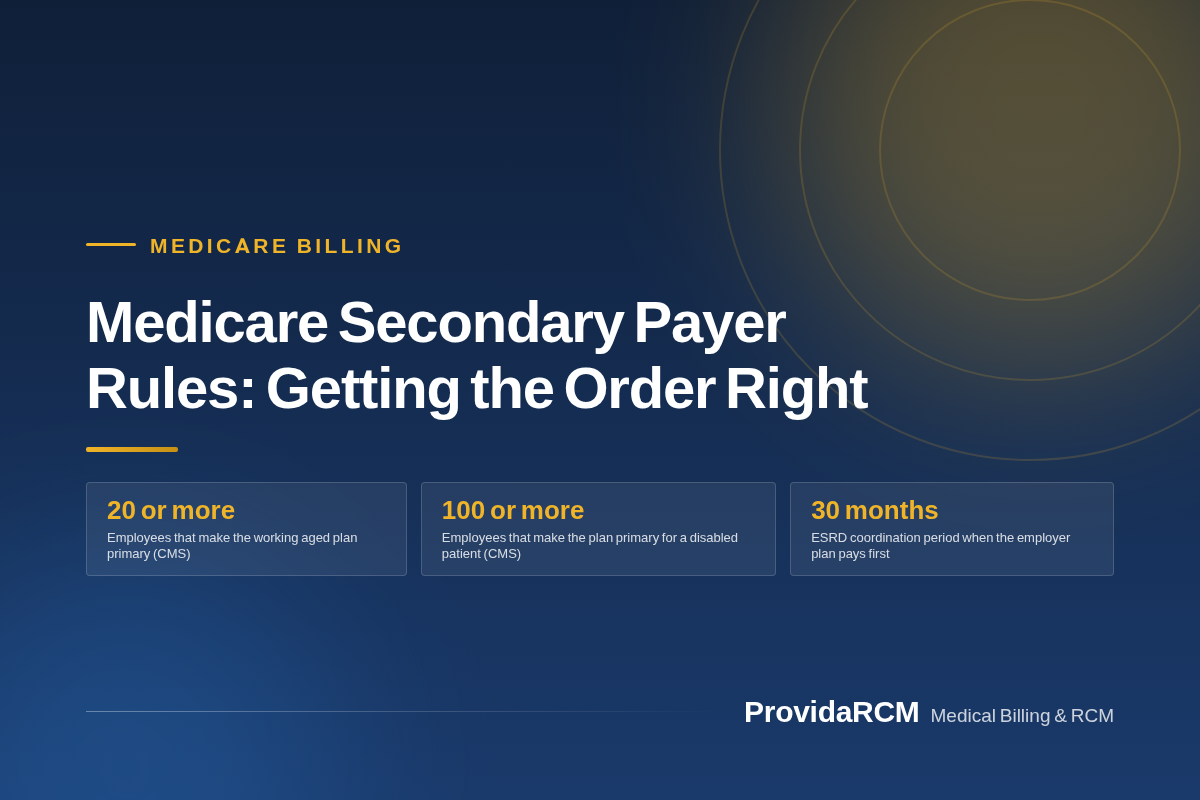
The working aged provision applies only to group health plans of employers with 20 or more employees, and to multi-employer plans in which at least one employer employs 20 or more. Full-time and part-time employees on the employer’s rolls count, and the test is met when the employer has 20 or more employees for each working day in each of 20 or more calendar weeks. See MSP manual Chapter 2.
For a disabled beneficiary the number becomes 100 and the plan is called a large group health plan. Medicare is secondary for an LGHP covering employees of at least one employer that employed 100 or more full-time or part-time employees on 50 percent or more of its business days in the previous calendar year.
Employees on the employer’s rolls before the plan pays first
Source: CMS, Medicare Secondary Payer Manual, Chapter 2, sections 10.3 and 30.2, and CMS MLN006903.
A practice with three employees can still have a Medicare secondary claim. What matters is how many people work for the employer that offers the coverage. A small dental office whose 66-year-old office manager is covered under her spouse’s plan at a 400-employee manufacturer has a primary group health plan claim, and billing Medicare first creates an overpayment.
A multi-employer group health plan may elect Medicare as primary for employees of participating employers with fewer than 20 employees, under 42 CFR 411.172(b). That election has no counterpart on the disability side.
ESRD runs on a 30-month coordination period, not on an employee count
End stage renal disease is the one situation measured by a clock instead of a headcount. During the first 30 months of Medicare eligibility or entitlement based on ESRD, the group health plan pays first and Medicare pays second. When the period ends, Medicare takes the primary slot even though the plan is unchanged.
The period starts the first day of the month the person is eligible for Medicare because of kidney failure, whether or not they have enrolled, and CMS says it applies the same way to someone also entitled on the basis of age or disability. CMS describes the start as usually the fourth month of dialysis.
A 67-year-old with ESRD does not move onto the working aged track for ESRD-related care. The MSP manual holds the 30-month coordination period in place regardless of entitlement based on age or disability.
No-fault, liability, workers’ compensation and black lung
Four more situations put another payer ahead of Medicare, and none uses an employer size test. Liability insurance, including self-insurance, and no-fault insurance pay first for care related to the accident they cover. Workers’ compensation pays first when the condition is work related and the carrier has accepted it. The Federal Black Lung Program pays first for a black lung diagnosis.
The trigger is a fact you can only learn by asking. CMS requires providers to ask at admission or the start of care whether the condition came from an accident or incident another party may be responsible for, and whether it is work related. Where a patient denies coverage the practice believes applies, the manual calls for a supplementary statement describing the accident.
| Situation | What makes it primary | What the record needs |
|---|---|---|
| Liability and self-insurance | Another party is legally responsible for the injury | Name, address and policy number of the insurer |
| No-fault | Coverage that pays regardless of who caused the accident | The policy number and the date of the incident |
| Workers’ compensation | The condition is work related and the carrier is expected to pay | Employer, carrier and claim number, plus any denial reason |
| Black lung | Diagnosis relates to black lung and the patient is covered by the program | The diagnosis, and whether the service relates to the black lung condition |
Workers’ compensation and liability reporting duties are set state by state, and so are a carrier’s time frames to accept or deny a claim. The federal MSP provisions take priority over state law, but the rules your staff follows are local. Oregon is the clearest illustration: CMS states that providers there may bill either Medicare or liability insurance when the liability insurer pays within 120 days.
The Medicare Secondary Payer questionnaire, and the record it builds
Medicare’s answer to the fact problem is a script. The MSP manual, Chapter 3, section 20.2.1, holds the model Medicare Secondary Payer questionnaire. CMS expects it to be worked through at admission or the start of care, and institutional providers are told to review the questions each time they treat or admit a patient.
- Is the patient entitled to Medicare based on age, disability or ESRD? The answer sends you to a different part of the form.
- Is there group health plan coverage based on the patient’s own current employment, or the current employment of a spouse or another family member? If not, Medicare is primary.
- How many people work for that employer, including the patient or the spouse: 1 to 19, 20 to 99, or 100 or more? Medicare’s own form asks in those bands.
- For ESRD, has the patient had a kidney transplant or maintenance dialysis, when did dialysis begin, and are they inside the 30-month coordination period?
- For an injury, does the care relate to an accident or incident, a work-related condition, or a liability, no-fault or workers’ compensation claim?
The answers feed a record you do not own. Medicare posts an MSP record to the Common Working File, keyed to the beneficiary. The Benefits Coordination and Recovery Center builds it from claim data, your questionnaire responses, and insurer reporting under Section 111 of MMSEA.
| Source | What it shows | Who sees it |
|---|---|---|
| HETS 271 eligibility response | MSP type, the other payer, and the effective dates | Any practice with an eligibility connection |
| Common Working File | The MSP auxiliary file behind the 271, including open and closed records | MAC systems and portals |
| The completed questionnaire | The facts Medicare will eventually record, including negative answers | Front desk, at every visit |
CMS is explicit that not having access to the Common Working File or the 270/271 transaction does not excuse a practice from identifying the primary payer. Run the 271 before the claim, read the MSP segment, and compare it with the patient’s answers.
On the remittance, the code that reports a coordination problem is CARC 22, this care may be covered by another payer per coordination of benefits. X12 requires at least one remark code with it. CARC 20 and CARC 21 state the liability and no-fault versions of the same message.
When Medicare pays first in error: the demand, the clock and the appeal
Medicare may pay a claim as primary when the claim meets its billing and coverage rules, even if another payer should have gone first. When CMS learns that a primary payer existed, the money moves again. Group health plan recoveries go to the Commercial Repayment Center; injury-related recoveries go to the Benefits Coordination and Recovery Center.
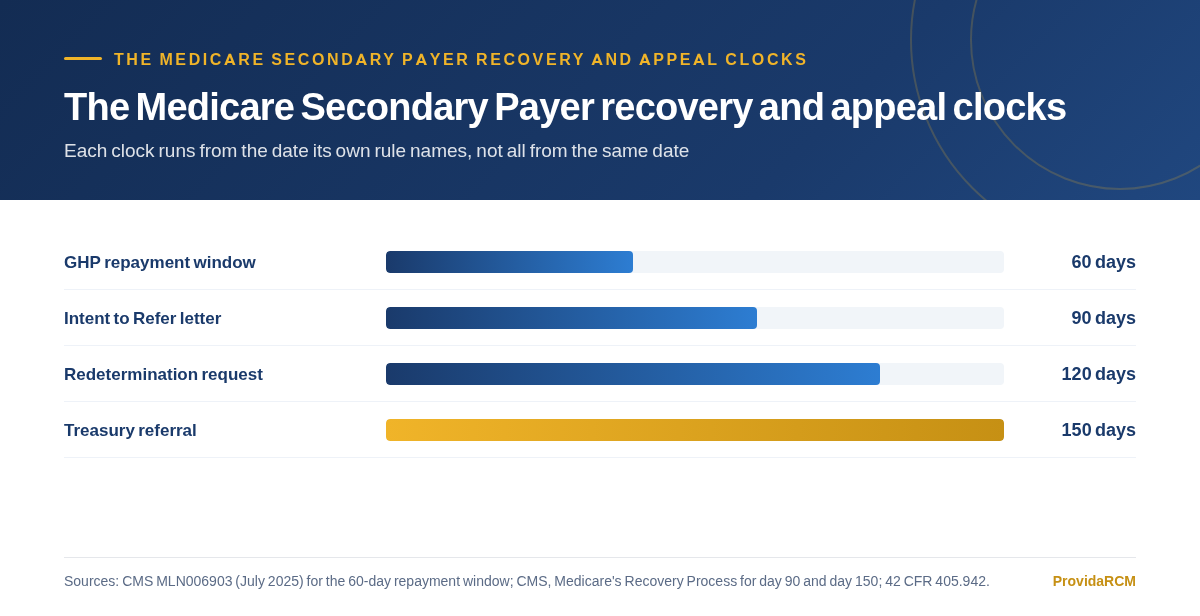
The demand letter names the beneficiary, the date of the incident, a summary of the conditional payments Medicare made, the total owed, and the waiver and appeal rights. A primary payer, or an entity paid by one, has 60 days to reimburse Medicare, counted from the date CMS learns that payment was or could have been made by a primary payer.
- 01
The demand letter
The contractor lists the conditional payments Medicare made and the amount owed, with the waiver and appeal rights printed on it. Interest starts on this date.
- 02
Day 90: Intent to Refer
If full payment or a valid documented defense has not arrived, the contractor sends notice that it intends to refer the debt to the Treasury Offset Program.
- 03
Day 150: referral
Sixty days after the Intent to Refer letter, a debt that is still open is referred for collection, and CMS may also refer it to the Department of Justice.
Windows on a claim billed to the wrong payer
Sources: 42 CFR 405.942(a) for the redetermination request; MSP Manual, Chapter 3, section 10.5, for the reopening windows.
An appeal runs on the ordinary Medicare clock. A request for a redetermination goes to the contractor within 120 calendar days of the notice of the initial determination, and 42 CFR 405.942 presumes the notice arrived five days after its date unless there is evidence to the contrary. Filing does not pause interest.
Conditional payments are where practices lose money. Medicare can pay a contested non-ORM liability, no-fault or workers’ compensation claim while the case is open, but only where the claim went to the primary payer first and that payer did not pay inside the 120-day paid promptly period.
Front desk, biller, and fixing the order without losing the claim
Everything above depends on two people doing small things at the right moment. The front desk owns the facts, because the questionnaire is the only place the employer, the injury and the new job get captured. The biller owns the order. A wrong order is fixed with a corrected claim or a reopening, not an appeal.
- Ask the MSP questions at every visit, including return visits and established patients
- Record negative answers as carefully as positive ones, and keep them for 10 years after the service date
- Read the MSP segment of the 271 response against what the patient told the front desk
- Put the other payer’s name, policy information and paid amounts in the claim before it goes out
- Send the claim to the primary payer first, and keep its explanation of benefits with the Medicare claim
- 01
Bill the primary payer first
Send the claim to the plan that owns the primary slot and wait for its explanation of benefits. Keep the paid amount and the denial reason.
- 02
If Medicare already paid, do not appeal
An appeal contests a denial, and what you have is a payment to the wrong payer. For a group health plan case, submit the corrected claim or ask the MAC to reopen its determination.
- 03
Watch the reopening window
An initial determination may be reopened for any reason within one year. Between one and four years good cause is required, and a third party paying primary by mistake is not good cause by itself.
Two controls carry most of this work. A disciplined insurance verification routine catches order changes before a claim exists, and a clean claim rate you actually track tells you whether the front end is holding. When coordination volume shows up in a denial code review, treat it as an MSP record problem rather than a billing error.
Questions practices ask us about this
Who pays first when a patient has Medicare and a job-based plan?
It depends on current employment and the size of the employer. For a patient 65 or older with coverage from current employment, the group health plan pays first when the employer has 20 or more employees. For a disabled patient under 65, the large group health plan pays first at 100 or more.
Why does the employee count matter if my practice is small?
The size test describes the employer that offers the coverage, not the practice that bills the claim. A three-person practice can hold a claim where a 400-employee manufacturer’s plan is primary. The 20-employee test is met when the employer has 20 or more full-time and part-time employees on its rolls for each working day in 20 or more calendar weeks.
How long is the ESRD coordination period?
Thirty months. During the first 30 months of Medicare eligibility or entitlement based on end stage renal disease, the group health plan pays first and Medicare pays second. The period starts the first day of the month the person is eligible because of kidney failure, usually the fourth month of dialysis.
Does Medicare pay for an injury claim while the liability case is open?
Sometimes, and the conditions matter. Medicare may make conditional payments on a contested non-ORM liability, no-fault or workers’ compensation claim. It will only do so where the claim went to the primary payer first and that payer did not pay inside the 120-day paid promptly period. A primary group health plan that was never billed blocks the conditional payment.
What is CARC 22 and how do we clear it?
CARC 22 reads, this care may be covered by another payer per coordination of benefits. X12 requires at least one remark code with it. It usually means the payer order was wrong on submission, or that an MSP record exists that the claim did not reflect. Clear it by checking the 271 response and resubmitting to the correct first payer.
Do we really have to ask the MSP questions at every visit?
CMS tells institutional providers to review or administer the MSP questions each time they treat or admit a patient, and to ask patients to update their insurance profile at each visit. Answers change without notice: a patient turns 65, a spouse changes jobs, a retiree returns to full-time work.
Want this fixed in your practice?
We run full-cycle billing, coding, credentialing and denial work for practices across the country. Send us a few months of claims and we will show you where the money is going.
Book a free billing review- CMS, MLN006903 Medicare Secondary Payer booklet, July 2025. cms.gov/files/document/mln006903-medicare-secondary-payer.pdf
- CMS, Medicare Secondary Payer Manual, Chapter 2, MSP Provisions. cms.gov/regulations-and-guidance/guidance/manuals/downloads/msp105c02.pdf
- CMS, Medicare Secondary Payer Manual, Chapter 3, Billing Requirements. cms.gov/regulations-and-guidance/guidance/manuals/downloads/msp105c03.pdf
- eCFR, 42 CFR part 411 subpart F, ESRD special rules. ecfr.gov/current/title-42/chapter-IV/subchapter-B/part-411/subpart-F
- eCFR, 42 CFR part 411 subpart D, liability and no-fault limits. ecfr.gov/current/title-42/chapter-IV/subchapter-B/part-411/subpart-D
- eCFR, 42 CFR 405.942, filing a redetermination. ecfr.gov/current/title-42/section-405.942
- CMS, Reimbursing Medicare. cms.gov/medicare/coordination-benefits-recovery/overview/reimbursing
- CMS, Medicare’s Recovery Process. cms.gov/medicare/coordination-benefits-recovery/beneficiary-services/recovery-process
- X12, Claim Adjustment Reason Codes, current list. x12.org/codes/claim-adjustment-reason-codes