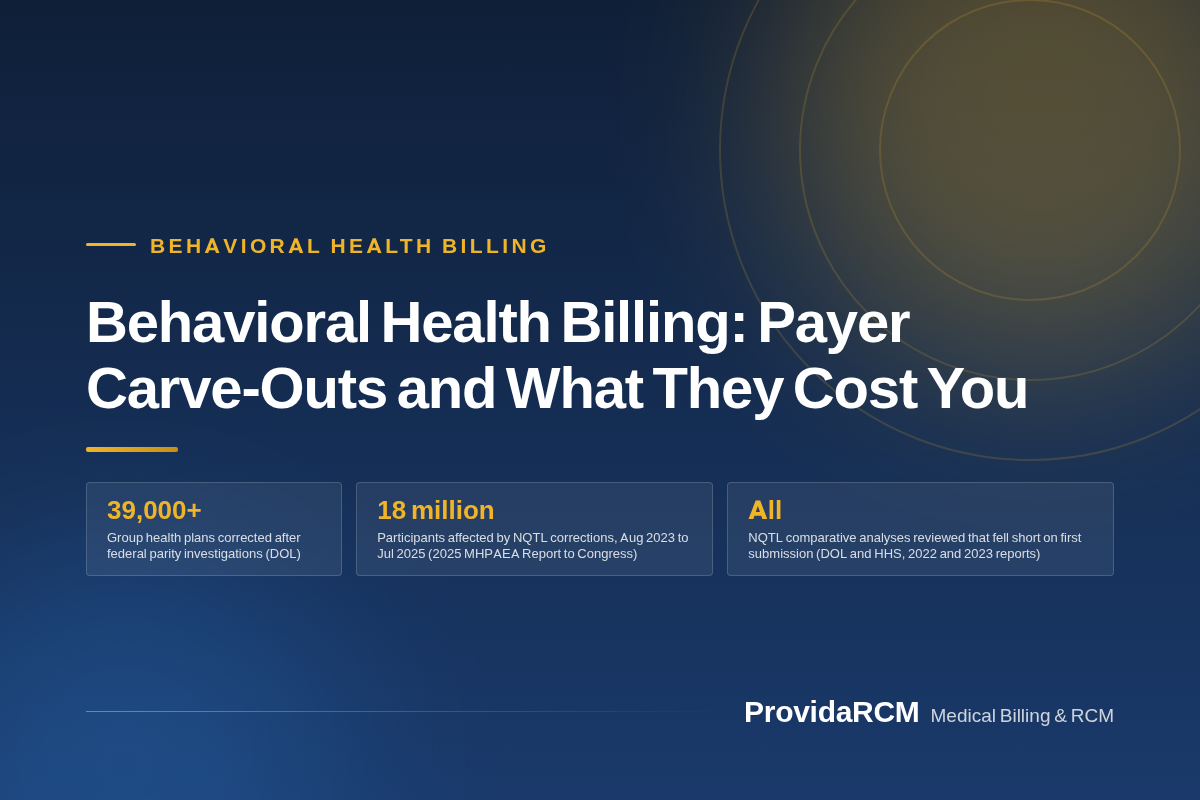
A behavioral health carve-out is when the medical plan hands the mental health and substance use benefit to a separate company, so the claim does not go where the medical claim goes. In behavioral health billing that means a second eligibility check, a second authorization vendor, a second claim address and a second appeal path.
How to tell whether a patient’s behavioral health benefit is carved out
A carve-out is a delegation. The health plan keeps the medical and surgical benefit and hands the mental health and substance use disorder benefit to a separate company, which usually runs its own eligibility, utilization review and payment. The medical claim and the behavioral health claim then travel on two tracks, and only one is familiar to your front desk.
Four places tell you which track applies. The member card is the fastest: a second logo or a behavioral health phone number under the medical customer service line is a strong signal. The eligibility response is the most reliable, because the payer identifier returned for the behavioral health service will not match the medical one. A benefit-specific authorization number is usually the vendor’s intake line. A wrong-payer denial names the entity that should have received the claim.
Two payer examples make the pattern concrete. Anthem’s employer guide says Carelon Behavioral Health, described there as a separate company, provides behavioral health services for Anthem Blue Cross and Blue Shield members (Anthem, employer benefits guide). UnitedHealthcare’s provider page for its Nebraska Medicaid plan routes behavioral health eligibility, prior authorization and claims through Optum Provider Express and publishes a separate behavioral health clinical line (UnitedHealthcare Community Plan of Nebraska).
| Element | On the medical benefit | On a carved-out behavioral health benefit |
|---|---|---|
| Member card | Plan logo and one customer service number | Often a second card or a separate behavioral health line |
| Eligibility response | Payer identifier for medical services | A different payer identifier or benefit code for MH/SUD services |
| Prior authorization | The plan’s utilization review department | The vendor’s own intake and review unit |
| Claim submission | Payer ID and address for medical claims | Vendor payer ID and a separate claims address |
| Fee schedule | The medical network contract rate | The vendor’s rate, which may be a different schedule |
| Appeal | The plan’s appeal unit and its published timeframe | The vendor’s appeal unit, with its own address and timeframe |
An employee assistance program is a separate employer-funded benefit with its own session cap, and those sessions usually carry no deductible and no copay. Cigna’s EAP materials for one employer plan describe up to ten short-term counseling sessions at no cost to the member, with later visits rolling into the medical plan’s behavioral benefit (Cigna EAP FAQ). Billing an EAP visit to the medical plan is the mistake that follows.
What changes in behavioral health billing when the benefit is carved out
Once the benefit is delegated, six back-office tasks stop behaving the way they do for medical claims. Together they explain why a behavioral health account takes longer to stabilize than a primary care account of similar size.
- Eligibility: verify the medical benefit for medical services and the behavioral health benefit separately, and record each payer identifier the response returns.
- Authorization: send the request to the behavioral health vendor, not the medical prior authorization line, and keep the vendor’s name with the authorization number.
- Claim routing: file to the behavioral health payer ID and address, which is often a PO box different from the medical claims address on the same card.
- Fee schedule: load the vendor’s allowed amount, because the behavioral health rate is frequently not the medical network rate.
- Appeals: keep the vendor’s appeal address, levels and deadlines next to the plan’s, since a plan-level appeal sent to the medical payer never reaches the right reviewer.
- Records and peer to peer: expect a vendor-specific release form for documentation requests, and request the peer-to-peer review with the vendor’s clinician.
The failure mode is predictable. A claim goes to the medical payer because that is the address the office already has. It comes back as a wrong-payer denial weeks later, and part of a filing window is gone. That rework repeats on every new patient until someone fixes the payer table.
Denial reports circulate codes that payers retired years ago. X12 keeps deactivated codes in its published list, so an old code can still look current in a scraped table. CO-15, the pre-2018 authorization code, was deactivated on 1 May 2018 and still appears in current denial analyses. Check every code against the current X12 list before you build a rule on it.
Why a carve-out usually narrows the network
A carve-out vendor is paid to manage a benefit, and the levers it holds are network composition, utilization review and rate. Federal enforcement reports treat that as a known risk. The July 2023 MHPAEA report to Congress lists network adequacy among the Department of Labor’s priorities, notes that patients report difficulty finding in-network providers, and states that the department was pursuing more than 20 investigations into provider network admission standards.
The 2024 report to Congress records what plans agreed to change. Plans removed treatment limitations not imposed on medical or surgical benefits, including limits based on a failure to demonstrate improvement or progress, and limits tied to completing a full continuum of care at a treatment facility. They also updated the time and distance metrics behind provider network participation standards.
Reductions the behavioral health vendor reports, 2024
Source: Anthem, citing Carelon Behavioral Health 2024 program evaluation data.
At the desk that means narrower choice, not necessarily a worse benefit. A network built around a vendor’s contracted clinicians can be thin in one county and adequate in the next. Before you accept a referral pattern, ask the vendor for its in-network list in the patient’s ZIP code. A patient who cannot find a clinician either goes out of network or stops scheduling.
Two sets of medical necessity criteria, and who applies them
The medical plan’s medical policy does not govern a carved-out behavioral health claim. The vendor’s own clinicians apply the vendor’s criteria, which is why an appeal that quotes the plan’s medical policy gets upheld without a substantive review.
Federal parity enforcement has already pulled apart some of those criteria. Between February 2021 and July 2022, 104 plans and issuers agreed to prospective changes addressing 135 treatment limitations, 71 of them unique. The limits that came out are familiar to anyone billing behavioral health: no coverage tied to a failure to show improvement.
Treatment limits corrected after federal parity reviews
Source: DOL, HHS and Treasury, MHPAEA Comparative Analysis Report to Congress, July 2023.
To appeal against criteria you did not write, pull the vendor’s criteria for the billed service, answer each one in order, and give the reviewer the documentation that satisfies it. Then check the plan document, because the plan, not the vendor, owns the benefit design and owes an explanation for the limit applied.
The July 2023 report describes a plan whose comparative analysis was assembled from information generated separately by its medical claims processor and its behavioral health claims processor, which the report calls unrelated entities. Each provider named different factors behind the same limit, and the analysis never compared them.
What a carve-out costs your practice
No federal source publishes a per-claim cost for a behavioral health carve-out, and any benchmark claiming to price one deserves suspicion. What a practice can measure is the extra work, and it is countable in six places.
| Cost line | What drives it | Where it shows up |
|---|---|---|
| Re-filed claims | The first submission went to the medical payer | Wrong-payer denials, then a second submission inside a shrinking filing window |
| Duplicate eligibility work | The behavioral health benefit has to be verified separately | Front desk minutes per new patient, and coverage missed at check-in |
| Split appeals | Two appeal addresses, two sets of levels and deadlines | Appeals worked late or not at all, because the calendar lives in one place |
| Out-of-network leakage | Thin vendor networks in some counties | Patients who cannot find an in-network clinician, or who stop scheduling |
| Authorization churn | The vendor reviews against its criteria, not the plan’s policy | Retrospective reviews and repeated clinical documentation requests |
| Credentialing time | You may need to enroll with the vendor as well as the plan | Non-billable administrative time, and claims held while enrollment completes |
Filing windows are where the money actually leaves. Most payers measure timely filing from the date of service, so a claim filed to the wrong payer and denied three weeks later does not get a fresh clock because the practice learned something. Some plans honor the original submission date when you send proof of the earlier filing. That is why the payer table, not the appeal nurse, is the control that pays.
Two published posts go deeper on the adjacent work: claim denial codes explained for the remittance side, and ABA billing units and authorizations for what a vendor authorization looks like when the units are under review. An eligibility verification check before the visit prevents most of the rework above.
The parity rules that constrain how a plan may manage the behavioral health benefit
MHPAEA is the federal law that limits how far a plan can go in managing a behavioral health benefit. It does not prohibit a carve-out. It requires that financial requirements such as copays and coinsurance, and treatment limitations such as visit caps and prior authorization, be no more restrictive for mental health and substance use disorder benefits than the predominant requirements applied to substantially all medical and surgical benefits in the same classification (CMS, MHPAEA).
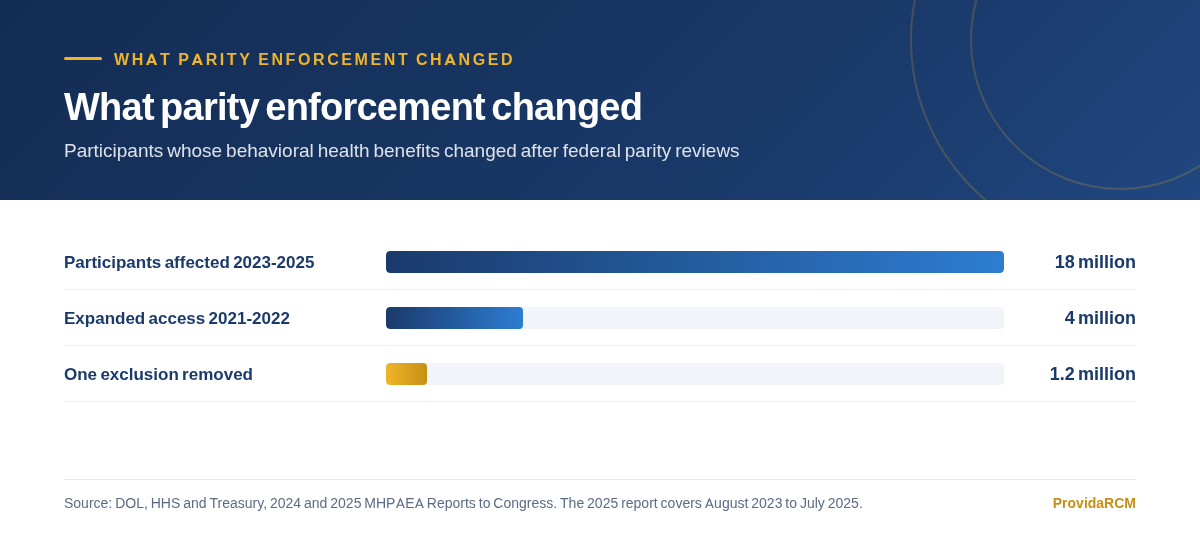
One timing note matters right now. The 2024 final rule that added detailed comparative analysis requirements and response timelines is subject to a nonenforcement policy the three departments issued on 15 May 2025. It covers the parts of the rule that are new relative to the 2013 final rule, and it runs until a final decision in the pending litigation plus 18 months (Statement of the Departments, 15 May 2025). The statutory duty to perform and document NQTL comparative analyses, added by the Consolidated Appropriations Act, 2021, still applies.
Three questions come up constantly on a carved-out account. Parity does not require a plan to cover behavioral health at all, so an exclusion is a design decision rather than a parity problem. A plan may delegate the benefit to a vendor, and the vendor’s criteria and network still have to meet the same test. Separate treatment limitations that apply only to MH/SUD benefits are prohibited.
How to raise a parity question when denials form a pattern
A single denial is not evidence of a parity violation, and a practice that writes that into an appeal loses credibility. What a practice can build is a pattern: the same limit, from the same vendor, on the same service, across enough claims to force an answer.
- 01
Log the pattern, not the claim
Track the denial reason, the vendor, the billed service and the plan for every behavioral health denial over 90 days. One vendor applying one limit to one service across many claims is the shape a parity question needs.
- 02
Ask the plan for the limit, in writing
Request the plan document language and the criteria applied to the service. The plan owns the benefit design and is the party that has to explain the limitation.
- 03
Ask about the comparative analysis
Federal law requires a plan imposing a nonquantitative treatment limitation to document a comparative analysis and to make it available to the federal departments or a state authority on request. A practice is not the requester, but a state insurance department or the Department of Labor is.
- 04
Escalate to the right enforcer
For an employer-sponsored plan, the Employee Benefits Security Administration takes the complaint at askebsa.dol.gov or 1-866-444-3272. For individual coverage, it is the CMS help desk or the state insurance department. For Medicaid managed care, the state Medicaid agency.
- 05
Keep the file that supports it
Save the denial notices, the criteria you were given, the authorization records and the payer identifier from each eligibility response. A pattern with dates and documents is a complaint. One without them is an opinion.
Write to the plan or the department in the language of a question: which criteria govern this service, how were they applied to these claims, and what comparative analysis supports them. Asserting a violation invites a form rejection. Asking a specific question about a documented pattern gives a regulator something to investigate.
If you would rather have the pattern found for you, our mental health billing services cover behavioral health and ABA accounts end to end, and prior authorization services handle the vendor side of the authorization work. For denials already on the books, denial management services work the appeal address that owns the claim.
Questions practices ask us about this
What is a behavioral health carve-out in medical billing?
It is a delegation of the mental health and substance use disorder benefit to a separate company, while the medical and surgical benefit stays with the plan. The vendor usually runs its own eligibility, utilization review and payment, so a behavioral health claim goes to a different payer identifier and address than a medical claim.
How do I find out if a patient’s mental health benefit is carved out?
Check three things. Look for a second logo or a behavioral health phone number on the member card. Compare the payer identifier on the eligibility response with the medical one. Call the authorization number printed for behavioral health services and see who answers, because that tells you which company handles the benefit.
Is an EAP visit billed to the patient’s insurance?
Usually it is not a claim against the medical benefit. An employee assistance program is a separate employer-funded benefit with its own session cap, and the sessions typically carry no deductible and no copay. Cigna’s own EAP materials for one employer plan describe up to ten short-term counseling sessions at no cost, with later visits rolling into the medical plan’s behavioral benefit.
Can a plan send behavioral health claims to a different company than medical claims?
Yes. Federal parity law does not prohibit a plan from delegating the behavioral health benefit or from using a separate claims processor. It does require that the limits applied to that benefit be no more restrictive than those applied to substantially all medical and surgical benefits in the same classification, and that the plan document its NQTL comparative analysis.
Does parity mean the plan has to cover behavioral health?
No. MHPAEA does not require a group health plan to cover mental health or substance use disorder benefits at all. It constrains how a plan that does offer them may manage them. That distinction matters when you triage a denial.
Where can a practice escalate a pattern of behavioral health denials?
For an employer-sponsored plan, the Employee Benefits Security Administration takes complaints at askebsa.dol.gov or 1-866-444-3272. For individual or marketplace coverage, use the CMS help desk or the state insurance department. For Medicaid managed care, use the state Medicaid agency. Send the pattern with dates and documents, and ask a specific question.
Want the carve-out mapped for your practice?
We verify the behavioral health benefit separately, file to the right payer identifier, and work the vendor’s appeal path. Send us 90 days of behavioral health claims and we will show you where the rework sits.
Book a free billing review- U.S. Department of Labor, EBSA, Mental Health Parity and Addiction Equity Act (MHPAEA) FAQs. dol.gov/agencies/ebsa/about-ebsa/our-activities/resource-center/faqs/mhpaea-1
- CMS, The Mental Health Parity and Addiction Equity Act (MHPAEA). cms.gov/marketplace/private-health-insurance/mental-health-parity-addiction-equity
- DOL, HHS and Treasury, Statement Regarding Enforcement of the Final Rule on Requirements Related to MHPAEA, May 15, 2025. dol.gov/sites/dolgov/files/ebsa/laws-and-regulations/laws/mental-health-parity/statement-regarding-enforcement-of-the-final-rule-on-requirements-related-to-mhpaea.pdf
- DOL, HHS and Treasury, 2025 MHPAEA Report to Congress. beta.dol.gov/system/files/research-data/2026-02/2025-mhpaea-report-congress.pdf
- CMS, 2024 MHPAEA Report to Congress, January 2025. cms.gov/files/document/2024-mhpaea-report-congress.pdf
- DOL, MHPAEA Comparative Analysis Report to Congress, July 2023. dol.gov/agencies/ebsa/laws-and-regulations/laws/mental-health-parity/report-to-congress-2023
- Anthem, Meeting the challenges of mental health care (employer benefits guide). anthem.com/employer/the-benefits-guide/meeting-the-challenges-of-mental-health-care
- UnitedHealthcare Community Plan of Nebraska, Behavioral Health provider page. uhcprovider.com/en/health-plans-by-state/nebraska-health-plans/ne-comm-plan-home/ne-cp-bh.html
- Cigna Healthcare, Employee Assistance Program (EAP) frequently asked questions. welcome.cignahealthcare.com/eap-faq
- X12, Claim Adjustment Reason Codes (current list). x12.org/codes/claim-adjustment-reason-codes