Patient collections scripts work when they sit on a written policy, not on goodwill. The five conversations that decide whether a practice collects happen on the pre-visit call, at check-in, when a patient says they cannot pay, on the follow-up call for an unpaid statement, and at the handoff to a manager. Each needs a goal, workable words, and a record.
Patient collections scripts need a written policy behind them
A script without a policy is a preference. The moment a patient pushes back, a staff member with no written rule either gives in or argues, and both endings cost money. The policy states what the practice charges, when it asks, what it accepts, and who may change the terms. The script is that policy spoken aloud.
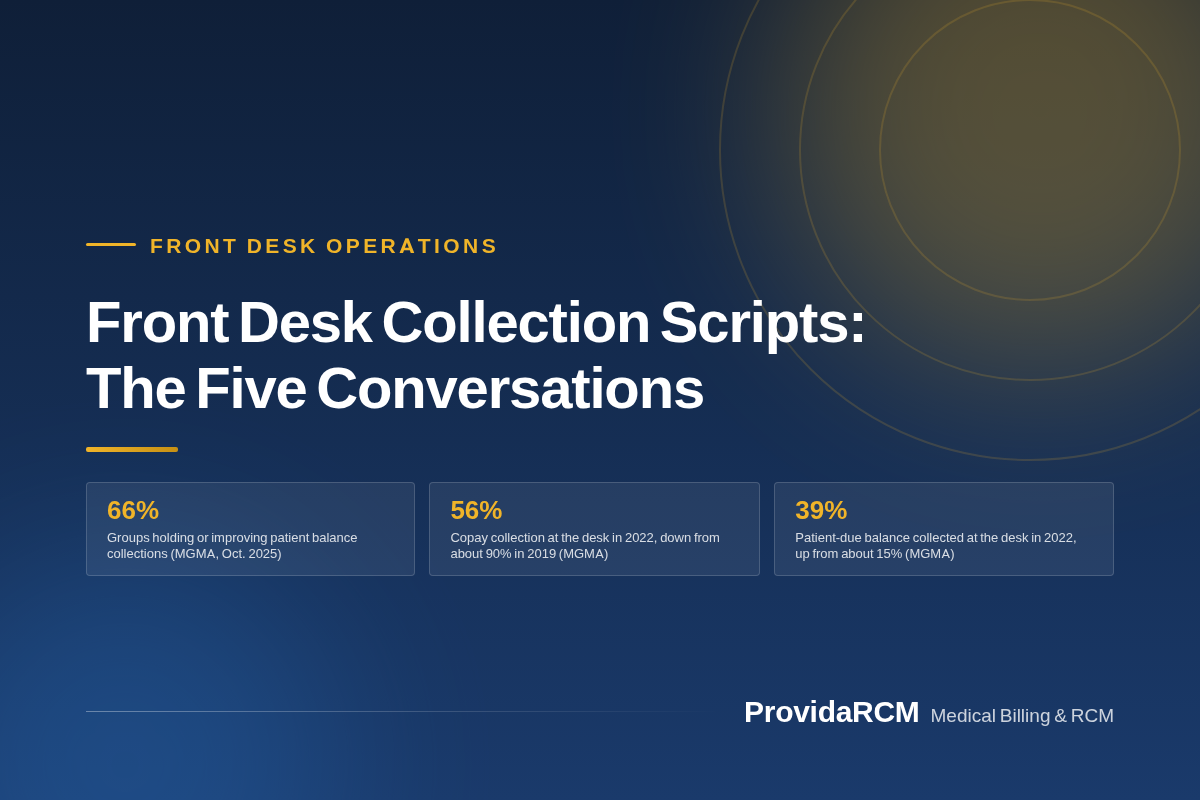
MGMA Stat’s Oct. 21, 2025 poll found 66% of medical group leaders reporting patient balance collections flat or better than the year before, across 247 applicable responses. The practices that improved most pointed to tighter time-of-service collection, clearer estimates, and named accountability for the front desk and billing team (MGMA Stat). Those are decisions, not phrases.
Patient balance collections versus a year ago, 2025
Source: MGMA Stat poll, Oct. 21, 2025, 247 applicable responses.
A practice that has not written down its statement schedule, plan terms, small-balance cutoff and escalation trigger has no script to teach. Staff invent one under pressure, and two patients with the same balance get two different answers.
Four decisions have to exist on paper first: how many statements leave and how far apart, who may reduce a balance and by how much, the smallest balance worth a phone call, and the exact day a balance escalates.
The five front desk conversations at a glance
These are five jobs, not five recitals of one paragraph. Each has a different goal, different words that work, and a different record the staff member has to leave.
| Conversation | When | What it has to accomplish | The record it leaves |
|---|---|---|---|
| Pre-visit call | 2 to 3 days ahead | Confirm coverage and quote the estimated share | Eligibility result and estimate given |
| Check-in | Day of service | Collect the copay and any known balance | Amount asked, collected, method |
| Cannot pay today | At the desk or by phone | Offer a plan, a deposit, a card on file | Plan terms, deposit, card authorization |
| Follow-up call | After statement one or two | Find out why it has not paid, then fix that | Call date, outcome, next action |
| Manager handoff | After the scripted steps | Move a stalled account without arguing it | Reason, dates and amounts |
The fourth column is the one practices drop. A conversation that leaves no record cannot be measured, cannot be handed off, and cannot be defended if a patient disputes what was said.
Conversation one: the call before the visit
The call two or three days before the appointment has one job: remove the surprise. The staff member confirms the plan is active, confirms the remaining deductible and the copay, and quotes a share the patient can plan around. The insurance verification checklist lists the fields that change the answer.
The language leads with the visit, not the money. “This is Riverbend Family Medicine calling about your Thursday appointment. I checked your plan, your copay is $35, and there is $120 left on the deductible, so plan on about $155 at check-in. Would you like me to note a card so check-in is quick?” The figures are illustrative; the structure is the part to copy.
Self-pay and uninsured patients get a different call. Federal rules require a good faith estimate of expected charges, and the patient can dispute a bill that lands at least $400 above it (CMS explains the patient-side rules). Our post on good faith estimates covers who needs one and when.
- Name the visit first, then the amount: your Thursday appointment, then the copay and the remaining deductible.
- Say plan on about for anything not yet adjudicated, so the number cannot be read as a guarantee.
- Give the patient one question to answer: which card, rather than whether they will pay.
- Re-check that the plan is still active on the day of the call, because coverage changes on the first.
Promising a final amount before the claim adjudicates. A copay is fixed and can be quoted flatly. A deductible estimate is not, and a staff member who calls it what you owe has manufactured an argument the practice will lose six weeks later.
Conversation two: at check-in, asking for the copay and the balance
Check-in is the highest-yield minute in the practice and the easiest to get wrong. The goal is a payment, but the job is to ask in a way the patient already agreed to on the phone.
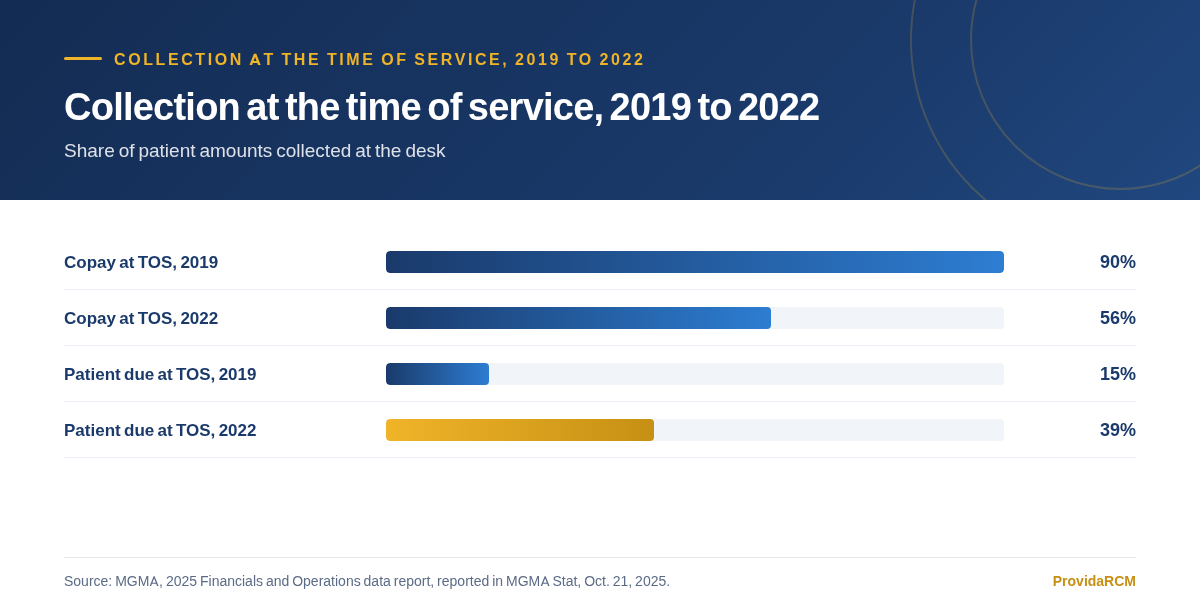
MGMA’s benchmarking shows the shift. Copay collection at the desk fell from about 90% in 2019 to 56% in 2022, while patient-due collection rose from about 15% to 39% across the same years.
The words: “Good morning, Ms. Alvarez. When we spoke Thursday your copay was $35 and you had $120 left on the deductible, so today works out to about $155. Shall I put the $35 on the card you used last time and settle the rest once the claim comes back?”
- State the amount before the card comes out; a total that surprises a patient invites a reversal.
- Offer a choice of method, not of whether: card, cash, or a plan set up with the billing office.
- Log the amount asked and the amount collected; the gap is the number you manage.
- Never read the difference between the billed charge and the allowed amount as a patient balance.
That last point has a code behind it. On the 835 remittance advice, group code PR means patient responsibility, and CARC 45 reports a charge above the fee schedule, maximum allowable or contracted rate (X12 code list). CARC 45 with group code CO is a contractual write-off, not a patient debt. A front desk that quotes the gap between charge and allowed amount is asking for money the contract already forgave.
Conversation three: the patient who cannot pay today
The patient who says they cannot pay today is rarely refusing. Most are telling the truth and bracing for an argument. The goal is to leave with one of three things: a payment plan the practice can see on a report, a deposit, or a card on file with written authorization.
MGMA guidance on patient A/R suggests terms a practice can adopt as its own: half the balance up front and the rest within six months for a typical account (MGMA Stat, Dec. 6, 2022). Those are MGMA’s suggested terms, not a legal rule. A practice sets its own minimum and length, writes them down, and applies them the same way to every account of the same size.
The script: “I understand, and it is not a problem. I can set you up at $60 a month with no interest, or if you can put $150 down today the rest can go to six months. Which fits better?”
How long practices wait before sending an account to collections
Source: MGMA Stat poll, Dec. 6, 2022, 519 applicable responses.
- A card on file with signed authorization turns a missed month into an agreed charge rather than a fresh call.
- A payment plan nobody can see on a report is not a plan; it is a note in a chart.
- The escalation point is the day the practice stops asking and moves the account, and it belongs in writing.
The staff member scripts three offers and then stops. If the patient will not choose a plan, a deposit, or a card on file, the account moves to the billing office on the written escalation day. Arguing past that point turns a balance into a complaint.
Conversations four and five: the follow-up call and the handoff
The follow-up call goes out only after a statement has gone unanswered. The goal is not the payment; it is to find out what stopped the payment, because the reason decides the fix. Our post on patient balance collection covers the statement side.
The script: “Mrs. Okafor, this is the billing office at Riverbend. Your statement from March 14 shows $240 still open. I am not calling to pressure you. I want to know whether the statement reached you and whether the amount matches what your plan told you.”
The handoff to a manager is a scripted step, not an escalation of volume. The manager repeats what the staff member established and adds authority the staff member does not have: a longer plan, a hardship adjustment, or a decision to refer the account out. “My colleague tells me this month is the problem. I have more room than she does.”
| Statement on the phone | Where the line sits | Why the line is there | Source |
|---|---|---|---|
| We can sue you, or garnish your wages | Prohibited if the action is not intended | A threat of unintended action is a false representation | 12 CFR 1006.18(c)(1) |
| We will report this to the credit bureaus | Prohibited if the practice knows it is false | Known-false credit information is a false statement | 15 U.S.C. 1692e(8) |
| Calls before 8 a.m. or after 9 p.m. | Outside the window for a debt collector | A collector convenience rule to hold to anyway | 12 CFR 1006.6(b) |
| More than seven calls in seven days | Presumed harassment for a debt collector | A ceiling a sane cadence stays under | 12 CFR 1006.14(b)(2) |
| The gap between charge and allowed amount | A contractual write-off, not a patient debt | The group code decides who bears it | X12 CARC 45 with group code CO |
None of those rules name a practice collecting its own money under its own name. The statute defines a debt collector, then excludes any officer or employee of a creditor while, in the name of the creditor, collecting debts for that creditor (15 U.S.C. 1692a(6)(A)). The same section brings a creditor back in when it collects its own debts under a name suggesting a third party is collecting.
Where a particular practice sits on that line is a question for its counsel. What a front desk controls is narrower: bill in the practice’s own name, keep every statement accurate, and hand any account that leaves to a vendor whose compliance program somebody has read (Regulation F). The CFPB’s summary of the limits is worth handing to every caller.
Training, cadence, and who owns the point-of-service number
Scripts decay. A front desk hired in January hears the language once and drifts by March. The fix is a short cadence: five minutes on one conversation at the weekly huddle, a monthly listen to two live calls, and a quarterly refresh of the policy language.
| Policy decision | What it has to state | Who owns it | The default that causes trouble |
|---|---|---|---|
| Statement schedule | How many statements go out and how far apart | Billing manager | Statements sent when staff has time |
| Small-balance cutoff | The smallest balance worth a call | Practice owner | A small balance chased above its value |
| Plan terms | Minimum monthly amount, maximum length, when offered | Billing manager | Plans offered only after collections start |
| Deposit rule | Which services need a deposit and how it is set | Practice owner | One staff member requests a deposit, another waives it |
| Escalation trigger | The exact day a balance leaves the practice | Practice owner | One account sent at 60 days, another at 300 |
| Card on file | Whether one is kept and what authorizes a charge | Practice owner and counsel | A saved card charged without written authorization |
Point-of-service collection is a rate, not a total. Divide the amount collected at the desk by the amount collectable at the desk, and watch the rate rather than the dollars. MGMA’s April 2017 poll found 59% of practices collecting more than the copay at the visit, 34% the copay alone, and 5% taking no payment before service (MGMA Stat).
What practices collect at the time of service
Source: MGMA Stat poll, April 2, 2017, 1,338 applicable responses.
The number needs one owner with a name. When point-of-service collection belongs to the front desk and follow-up belongs to billing and neither sees the other’s rate, the practice cannot tell a language problem from a staffing problem.
The scripts here are the second half of the work. The first half is the written policy, the training cadence, and the named owner.
Questions practices ask us about this
What is a front desk collection script?
It is the language a staff member uses at the five points where a patient payment is decided: the pre-visit call, check-in, the moment a patient says they cannot pay, the follow-up call on an unpaid statement, and the handoff to a manager. It is the practice’s written policy spoken plainly, with a goal and a record for each conversation.
Can a practice collect a deductible at the time of service?
Only where the plan and the participation agreement allow it. Some agreements require the practice to wait until the claim adjudicates before billing the patient anything, and the amount can change between the estimate and the remittance. Confirm the payer’s own rule first, then collect the copay and any known patient-due amount the agreement permits.
Is a medical practice a debt collector under the FDCPA?
The statute answers that by definition rather than by practice type. It defines a debt collector and then excludes any officer or employee of a creditor while, in the name of the creditor, collecting debts for that creditor, at 15 U.S.C. 1692a(6)(A). The same section pulls a creditor back in when it collects its own debts under a name suggesting a third party is collecting.
How many times can we call a patient about an unpaid balance?
The federal call-frequency rule binds debt collectors. Regulation F presumes a violation at more than seven calls about one debt in a seven-day period, and it bars calls before 8 a.m. or after 9 p.m. Whether a particular practice is bound is the same boundary question above. Those numbers are still a safe cadence to hold to.
What should the front desk say when a patient says they cannot pay today?
Offer a choice before the patient has to ask for one. The workable moves are a payment plan with a set monthly amount, a deposit today with the rest over a few months, or a card on file with written authorization. MGMA’s guidance suggests half up front and the balance within six months, framed as the practice’s own terms. If the patient will not choose, the account moves to billing at the written escalation point.
How do we measure point-of-service collection?
Measure it as a rate, not a total. Divide what was collected at the desk by what was collectable at the desk, and report that rate monthly by staff member and by payer. A rising dollar total can hide a falling rate when patient balances grow. One named owner reports the number, so the practice can tell a language problem from a staffing problem.
Want the patient balance work off your front desk?
We run patient statements, front desk collection process and full-cycle billing for practices across the country. Send us a few months of accounts and we will show you where the balances are leaking.
Book a free billing review- MGMA Stat, Collecting the patient’s responsibility for care (April 2, 2017 poll). mgma.com/mgma-stats/collecting-the-patient-s-responsibility-for-care
- MGMA Stat, Patient balance collection: What’s moving the numbers (Oct. 21, 2025 poll). mgma.com/mgma-stat/patient-balance-collection-whats-moving-the-numbers
- MGMA Stat, A structured approach to collecting patient A/R (Dec. 6, 2022 poll). mgma.com/mgma-stats/a-structured-approach-to-collecting-patient-a-r
- CFPB, What laws limit what debt collectors can say or do. consumerfinance.gov/ask-cfpb/what-laws-limit-what-debt-collectors-can-say-or-do-en-329
- 15 U.S.C. 1692a, FDCPA definitions, including the creditor exclusion. law.cornell.edu/uscode/text/15/1692a
- 12 CFR Part 1006, Debt Collection Practices (Regulation F). ecfr.gov/current/title-12/chapter-X/part-1006
- CMS, Medical bill rights and the No Surprises Act patient protections. cms.gov/initiatives/your-patient-rights/medical-bill-rights
- X12, Claim Adjustment Reason Codes and Group Codes (current list). x12.org/codes/claim-adjustment-reason-codes