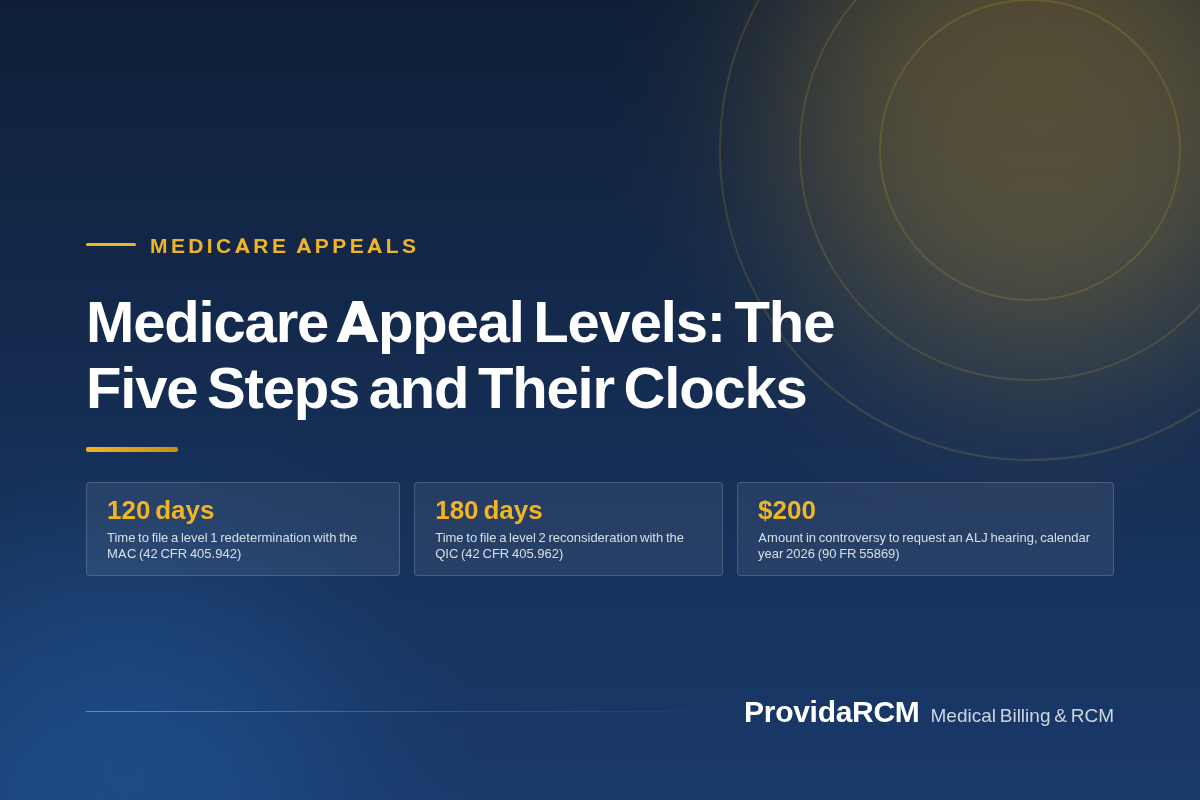
Medicare appeal levels run on five steps in original Medicare: a redetermination by your Medicare Administrative Contractor, a reconsideration by a Qualified Independent Contractor, a hearing before an administrative law judge, review by the Medicare Appeals Council, and judicial review in federal court. Every one of them is counted in calendar days from a notice.
The five Medicare appeal levels and the clock on each
Fee-for-service Medicare appeals live in one place: 42 CFR part 405, subpart I. which CMS restates in its booklet MLN006562, Medicare Parts A and B Appeals Process. Nothing here comes from the Medicare Advantage ladder in part 422, which runs on different clocks (Medicare Advantage denials).
The structure is a chain, not a menu. Level 1 goes to the contractor that denied the claim. Level 2 goes to an independent reviewer that contractor does not control. Levels 3 and 4 sit inside HHS. Level 5 leaves the agency. You cannot begin at level 3 because the reviewer there looks more promising.
| Level | Who decides | File within | Decide within | Amount in controversy | Form or route |
|---|---|---|---|---|---|
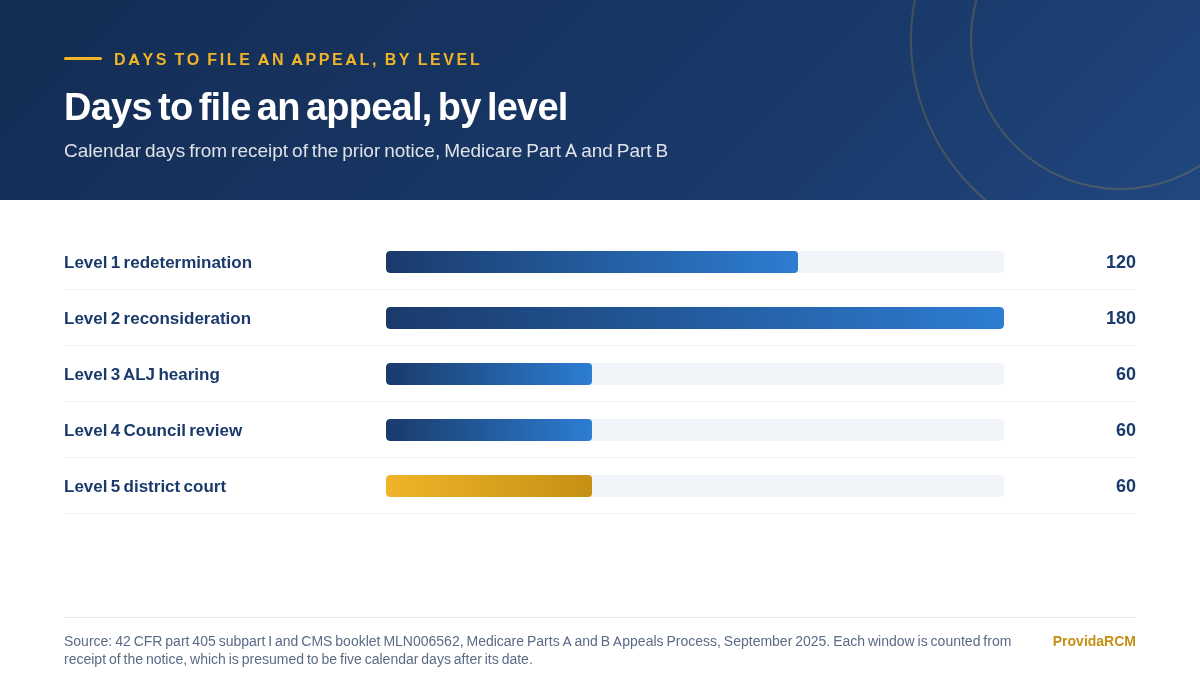
| 1. Redetermination | The Medicare contractor that issued the initial determination | 120 calendar days from receipt of the notice | 60 calendar days from receipt of the request | None | CMS-20027 or a written request |
| 2. Reconsideration | A Qualified Independent Contractor (QIC) | 180 calendar days from receipt of the redetermination notice | 60 calendar days from receipt of the request | None | CMS-20033 or a written request |
| 3. ALJ hearing | An administrative law judge or attorney adjudicator at OMHA | 60 calendar days from receipt of the QIC decision or dismissal | 90 calendar days, or 180 on escalation | Required, $200 in calendar year 2026 | OMHA-100, plus OMHA-100A for multiple beneficiaries |
| 4. Council review | The Medicare Appeals Council, HHS Departmental Appeals Board | 60 calendar days from receipt of the OMHA decision or dismissal | 90 calendar days, or 180 on escalation | None | DAB-101 or a written request |
| 5. Judicial review | A United States district court | 60 calendar days from receipt of the Council decision or its escalation notice | No statutory time limit | Required, $1,960 in calendar year 2026 | No HHS form |
How long the decider has to issue a decision
Source: 42 CFR 405.950, 405.970, 405.1016 and 405.1100, and CMS MLN006562 (September 2025). Timeframes can be extended, and an escalated appeal gets 180 days at OMHA and the Council.
Level 1: the redetermination you file with your MAC
A redetermination goes to the contractor that made the initial determination, and the request has to reach it within 120 calendar days of the date the practice receives the notice. Receipt is presumed to be five calendar days after that notice date unless there is evidence to the contrary. The request is filed on the day it arrives, not the day it was mailed.
The practice files Form CMS-20027 or a written request carrying the same elements. No minimum amount in controversy applies, so a $90 claim and a $9,000 claim take the same route. The contractor then has 60 calendar days from receipt to mail its notice. New evidence may be submitted with the request, and each later submission extends that period by up to 14 calendar days.
A full reversal ends the chain. An affirmance has to state how far it is unfavorable, summarize the facts and the clinical evidence used, explain how the coverage rules apply, and name any documentation that must accompany a reconsideration. That notice is the instruction sheet for level 2, and its missing-documentation paragraph is the first thing to read.
Every level starts its clock the same way. The notice is treated as received five calendar days after the date printed on it unless there is evidence to the contrary. A practice that opens a denial letter on day 12 of a 60-day window has 48 days left, not 60. Calendar the presumed receipt date, not the postmark.
Level 2: reconsideration at the QIC, and the evidence trap
A reconsideration is an independent, on-the-record review by a Qualified Independent Contractor. The practice files it within 180 calendar days of receiving the redetermination notice, on Form CMS-20033 or in writing, and no minimum amount in controversy applies (CMS, second level of appeal). The QIC has 60 calendar days from receipt to issue its written notice.
Where the dispute is whether an item or service is reasonable and necessary under section 1862(a)(1)(A) of the Act, a panel of physicians or other appropriate health care professionals has to consider the reconsideration, and a physician reviews a claim involving treatment furnished by a physician. The QIC is bound by national coverage determinations, CMS Rulings, precedential Council decisions, and the regulations. A local coverage determination does not bind it, though it gets substantial deference.
The reconsideration notice has to tell the parties that evidence not submitted before the QIC issues its reconsideration will not be considered at OMHA or above unless the appellant shows good cause for the delay. That sentence is the most consequential line in the ladder. A practice holding back the operative note for a level 3 hearing usually finds it excluded.
Level 2 is the last level where a medical necessity argument is cheap. The QIC reviews the same record the contractor reviewed plus anything submitted, and it can reverse on a different reading of that documentation.
Levels 3 to 5: OMHA, the Council, and federal court
Level 3 is a hearing before an administrative law judge at the Office of Medicare Hearings and Appeals. The practice files Form OMHA-100 within 60 calendar days of receiving the QIC’s decision or dismissal, and has to copy the other parties. An attorney adjudicator may decide on the record instead of holding a hearing. The adjudicator issues a decision, dismissal, or remand within 90 calendar days, or 180 when the appeal arrived by escalation (CMS, third level of appeal).
Level 3 adds the first money gate. The amount remaining in controversy has to meet a threshold the Secretary sets each year, and it is $200 for calendar year 2026 (90 FR 55869). Claims can be aggregated to reach it when they involve similar or related services or share common issues of law and fact, and Part A and Part B claims may be combined.
New evidence is admitted at level 3 only on a showing of good cause. The judge looks at whether it is material to an issue not identified before the QIC reconsideration, whether the practice could not obtain it despite reasonable attempts, and whether it had already been submitted to a contractor. Duplicative evidence can be excluded even when it is relevant.
Level 4 is review by the Medicare Appeals Council, in the HHS Departmental Appeals Board. The request goes in within 60 calendar days of receiving the OMHA decision or dismissal, on Form DAB-101 or in writing, and no amount-in-controversy requirement applies. The Council decides within 90 calendar days, or 180 if the case was escalated from OMHA. It reviews the record rather than holding a new hearing (CMS, fourth level of appeal).
Level 5 is where the case leaves the agency. A party files in United States district court within 60 calendar days of receiving the Council’s decision, and the amount remaining in controversy has to meet the judicial review threshold, which is $1,960 for calendar year 2026 (CMS, fifth level of appeal). No HHS form exists, the court has no statutory deadline, and the record before it is the administrative record.
Amount in controversy, calendar year 2026
Source: CMS, Medicare Appeals; Adjustment to the Amount in Controversy Threshold Amounts for Calendar Year 2026, 90 FR 55869, December 4, 2025. The level 3 figure is $200 and the judicial review figure is $1,960.
| Level | Standard the decider applies | New evidence | Amount in controversy | Effect on the next level |
|---|---|---|---|---|
| 1. Redetermination | Whether the initial determination was correct on the claim as filed | Allowed with the request, and later submissions extend the decision clock | None | An affirmance opens level 2, and its missing-documentation paragraph governs what level 2 accepts |
| 2. Reconsideration | Independent on-the-record review. NCDs, CMS Rulings and the regulations bind, while LCDs and manual guidance get deference rather than obedience | Allowed before the QIC decides. Evidence held back is excluded later absent good cause | None | The QIC decision is both the trigger and the clock source for level 3 |
| 3. ALJ hearing | Review of the QIC decision on the record, or at a hearing | Allowed only on good cause shown under 42 CFR 405.1028 | Required, $200 in calendar year 2026, and claims may be aggregated | The ALJ decision is reviewed by the Council rather than reheard |
| 4. Council review | Review of the ALJ or attorney adjudicator decision for error, on the record | Not a new evidentiary hearing. The Council reviews what the record contains | None | The Council decision is the final agency action and the trigger for federal court |
| 5. Judicial review | Whether the agency decision is supported by the evidence and correct as a matter of law | No. The administrative record is closed | Required, $1,960 in calendar year 2026 | Nothing inside Medicare sits above it |
When the decider does not decide: escalation
Escalation is the remedy for a contractor or adjudicator that does not decide. It applies at level 2 and above. If the QIC does not issue its reconsideration inside its window, the appellant may escalate to OMHA, and the judge then has 180 calendar days from OMHA’s receipt of the request. The case still has to meet the level 3 amount in controversy to be heard.
The same logic moves up the ladder. If no decision issues inside the OMHA window, the appellant may escalate to the Council, and a case that is not escalated stays at OMHA. If the Council does not decide in time, the appellant may ask it to escalate, and once the Council confirms it cannot decide within the statutory time frame, a party may file in district court within 60 calendar days of that notice.
Escalation is not a way around a weak record. It moves a case that has already stalled, and it does not reopen the evidence the practice skipped at level 2.
- Date every notice by its presumed receipt date: five calendar days after the date printed on it, unless a delivery record shows otherwise
- Track the two clocks at each level separately, the practice’s filing window and the decider’s decision window
- Set an internal filing date 14 days ahead of every external deadline, so a later evidence submission cannot eat the window
- Log the amount remaining in controversy at level 2, before a level 3 request depends on it
- Diary the escalation option on the day a decision window closes, not the day someone notices the case is idle
What has to be in the file, and what skipping a level costs
Each level asks for the same core set and then adds one thing. At level 1 the practice files the claim identifiers, the dates of service, a statement of why it disagrees, and any evidence supporting that. At level 2 it adds the missing documentation the redetermination notice identified. At level 3 it adds the amount remaining in controversy.
| The failure | What it looks like | What it forecloses |
|---|---|---|
| Filing late at level 1 | The request lands after 120 calendar days with no good-cause request attached | Level 2 and everything above it, because there is no reconsideration to appeal |
| Holding back a record at level 2 | The operative note is saved for the level 3 hearing | Its consideration at OMHA and above absent good cause, since level 2 is the last window where evidence enters as of right |
| Never filing a reconsideration | Claims go straight from the contractor to a level 3 request | Aggregation toward the level 3 threshold, which requires claims a QIC already reconsidered |
| Treating Medicare Advantage rules as these | A 60-day plan reconsideration is calendared against a MAC redetermination | The level 1 window, which is 120 days, not 60 |
| Ignoring the notice date | The clock is counted from the day the envelope was opened | Up to five calendar days on every level |
- The notice that starts the clock, with its print date and presumed receipt date written on it
- The form for the level, or a written request carrying every element the form would capture
- The evidence that level admits, matched to the reason in the denial notice
- Proof the other parties were copied, which levels 3 and 4 require
- A dollar figure for the amount remaining in controversy whenever the next level has a threshold
The ladder connects to the rest of the denial work. A medical necessity denial is answered the same criteria-first way at level 1 as anywhere else (medical necessity denial appeals), and the decision to spend on a reconsideration is the same arithmetic as any other appeal (which denials to appeal). The letter changes shape at each level (denial appeal letter templates), and the remittance code tells you which clock you are on (claim denial codes explained).
We run these calendars as part of denial management, sitting on full-cycle medical billing. The people who diary the redetermination deadline are the same people who scrub the claim before it goes out.
Questions practices ask us about this
How long do we have to file a Medicare redetermination?
120 calendar days from the date the practice receives the notice of initial determination. Receipt is presumed five calendar days after the date printed on it unless there is evidence to the contrary. The request is filed the day the contractor receives it, not the day it was mailed.
What is the difference between a redetermination and a reconsideration?
A redetermination is a review by the contractor that made the initial determination, filed on Form CMS-20027 within 120 calendar days. A reconsideration is an independent review by a Qualified Independent Contractor, filed on Form CMS-20033 within 180 calendar days of the redetermination notice. Both accept new evidence.
How much does a case have to be worth to go before a judge?
To request a hearing before an administrative law judge, the amount remaining in controversy has to meet a threshold the Secretary sets each year, which is $200 for calendar year 2026. Claims can be aggregated to reach it when they involve similar or related services or share common issues of law and fact.
What happens if the Medicare contractor never decides our appeal?
The appeal can be escalated. If the QIC does not issue its reconsideration in time, the appellant may move the case to the Office of Medicare Hearings and Appeals, where the judge then has 180 calendar days from receipt. If nothing issues in that window, the case can go to the Council.
Can we add new evidence at the administrative law judge level?
Only on a showing of good cause. The judge looks at whether the evidence is material to an issue not identified before the QIC’s reconsideration, whether the practice could not obtain it despite reasonable attempts, or whether it had already been submitted to a contractor.
Do these same appeal deadlines apply to Medicare Advantage?
No. Medicare Advantage appeals run under 42 CFR part 422, not part 405 subpart I. The first level is the plan’s own reconsideration, the window is 60 calendar days from receipt of the notice, and the independent review entity sits above the plan.
Want this fixed in your practice?
We run full-cycle billing, coding, credentialing and denial work for practices across the country. Send us a few months of claims and we will show you where the money is going.
Book a free billing review- eCFR, 42 CFR part 405 subpart I (Medicare Part A and B appeals). ecfr.gov/current/title-42/chapter-IV/subchapter-B/part-405/subpart-I
- eCFR, 42 CFR 405.1006 (amount in controversy for an ALJ hearing and judicial review). ecfr.gov/current/title-42/chapter-IV/subchapter-B/part-405/subpart-I/section-405.1006
- eCFR, 42 CFR 405.1102 (request for Council review). ecfr.gov/current/title-42/chapter-IV/subchapter-B/part-405/subpart-I/section-405.1102
- CMS, Medicare Parts A and B Appeals Process, MLN006562, September 2025. cms.gov/files/document/mln006562-medicare-parts-b-appeals-process.pdf
- CMS, second level of appeal: QIC reconsideration. cms.gov/medicare/appeals-grievances/fee-for-service/second-level-appeal
- CMS, third level of appeal: OMHA decision. cms.gov/medicare/appeals-grievances/fee-for-service/third-level-appeal
- CMS, fourth level of appeal: Council review. cms.gov/medicare/appeals-grievances/fee-for-service/fourth-level-appeal
- CMS, fifth level of appeal: judicial review in federal district court. cms.gov/medicare/appeals-grievances/fee-for-service/fifth-level-appeal
- Federal Register, adjustment to the amount in controversy thresholds for calendar year 2026, 90 FR 55869. federalregister.gov/documents/2025/12/04/2025-21879/medicare-program-medicare-appeals-adjustment-to-the-amount-in-controversy-threshold-amounts-for
- HHS Office of Medicare Hearings and Appeals, level 3 appeal forms. hhs.gov/about/agencies/omha/filing-an-appeal/forms/index.html
- HHS Departmental Appeals Board, appeals to the Medicare Appeals Council. hhs.gov/about/agencies/dab/different-appeals-at-dab/appeals-to-council/index.html