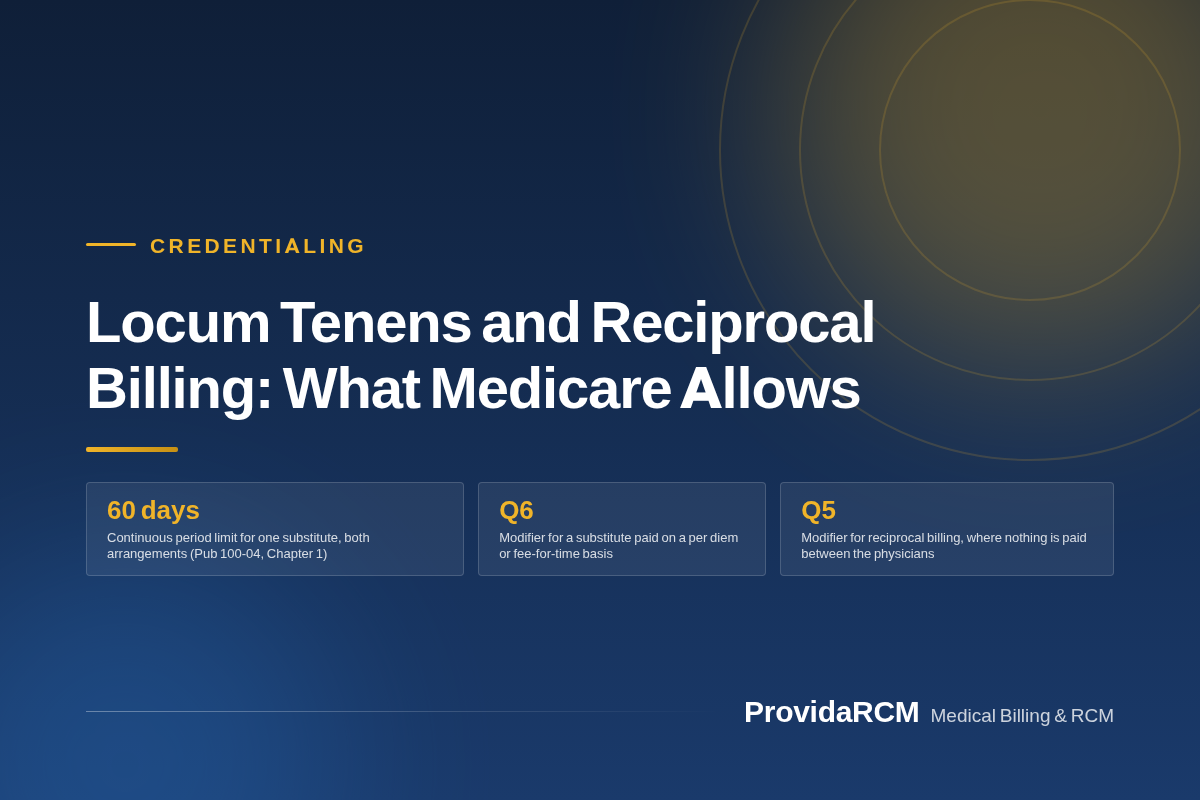
Medicare lets your practice bill for a covering physician’s work under two arrangements: a fee-for-time arrangement, still called locum tenens billing, where you pay the substitute a per diem and add modifier Q6, and reciprocal billing, where a colleague covers at no charge and you add modifier Q5. Both stop at 60 continuous days.
What Medicare allows when another physician covers your patients
Section 1842(b)(6)(D) of the Social Security Act lets Medicare pay the first physician for services a second physician furnishes to that physician’s patients, as long as the first physician is unavailable and the arrangement is either informal and reciprocal or involves per diem fee-for-time compensation. CMS restated both routes in a 2017 transmittal.
In 2017 CMS stopped calling the paid arrangement locum tenens, because the statute uses that phrase for both routes. The manual now calls it a fee-for-time compensation arrangement. The old name still runs through specialty society guidance, agency contracts and the modifier description.
| Question | Fee-for-time compensation (locum tenens) | Reciprocal billing |
|---|---|---|
| Money between the physicians | The regular physician pays the substitute a per diem or similar fee-for-time amount | Nothing is paid between them. The coverage is a favor between colleagues |
| Modifier on the claim | Q6 | Q5 |
| Continuous coverage limit | 60 days. Longer only for a physician called to active duty in the Armed Forces | 60 days. Extended on the same terms |
| Who bills and is paid | The regular physician or the group, under its own NPI, as though the regular physician performed the service | The regular physician or the group, on the same basis |
| Where the rule sits | Pub 100-04, Chapter 1, Section 30.2.11 | Pub 100-04, Chapter 1, Section 30.2.10 |
Locum tenens billing: the fee-for-time compensation rule
The manual describes the practice in plain terms. A physician retains a substitute to take over the practice during an absence for illness, pregnancy, vacation or continuing medical education, and bills for the substitute’s services as though he or she had performed them. A regular physician can be a specialist, so a cardiologist covering a colleague can be the substitute.
- The regular physician is unavailable to provide the services.
- The Medicare patient has arranged, or seeks, to receive the services from the regular physician.
- The regular physician pays the substitute on a per diem or similar fee-for-time basis.
- The substitute does not serve the regular physician’s Medicare patients for a continuous period longer than 60 days.
- The regular physician appends modifier Q6 after the procedure code, the modifier CMS words as a service furnished under a fee-for-time compensation arrangement by a substitute physician.
The continuous period is where practices get caught. It begins the first day the substitute furnishes covered visit services to your Medicare patients and ends the last day before you return to work. Days when nobody covers your patients, and days when a second substitute covers them, do not interrupt it. A new period can start only after you are back at work.
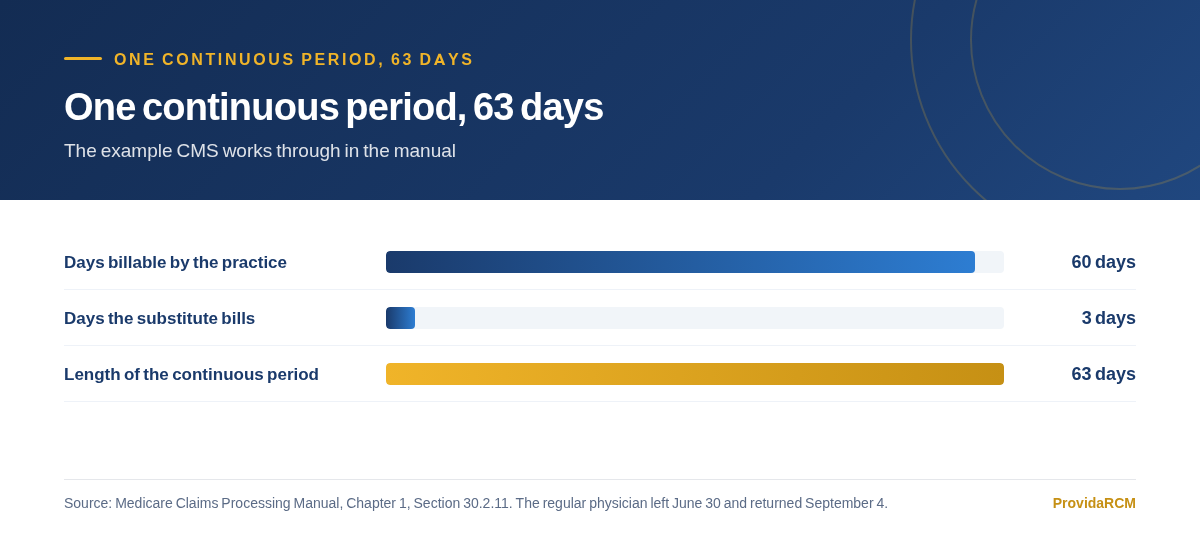
CMS works an example through the manual. The regular physician goes on vacation June 30 and returns September 4. A substitute covers July 2 through September 2, a 63-day continuous period. The practice can bill the first 60 days, July 2 through August 30. The services from August 31 through September 2 fall past the limit, and the substitute must bill those in his or her own name and billing number.
The regular physician submits the claim under his or her own NPI and receives the Part B payment when assignment is accepted. CMS prices the claim as though the regular physician provided the services, and identifies the substitute in the record for audit verification rather than for payment.
Entering Q6 is a certification, not a routing code. The contractor assumes the claim meets the requirements of the section unless it finds evidence to the contrary, so the 60-day period is not tracked before payment. A false certification can carry fraud penalties and revocation of billing privileges under 42 CFR 424.535.
Reciprocal billing: a colleague covers at no charge
Reciprocal billing covers the situation where another physician in town sees your patients as a favor while you are out. The statute treats an informal reciprocal arrangement as a separate route from fee-for-time compensation, and that is the only real difference between them. Where money moves, the modifier is Q6. Where it does not, the modifier is Q5.
- The regular physician is unavailable to provide the services.
- The Medicare patient has arranged, or seeks, to receive the services from the regular physician.
- The substitute does not serve those Medicare patients for a continuous period longer than 60 days.
- The regular physician appends modifier Q5 after the procedure code and keeps a record of each service furnished, with the substitute’s NPI, on file.
Two details surprise billing managers. A physician may hold reciprocal billing arrangements with more than one physician, and the arrangements need not be in writing. What has to exist is the record of services, because Q5 certifies that the services are identified in a record available for inspection.
For a group claim, the manual adds a condition to check first. The substitute may not have reassigned the right to Medicare payment to the group through an approved CMS-855R enrollment form. The group enters Q5, identifies the physician on whose behalf the services were furnished by NPI in item 24J of the CMS-1500, and keeps the service record with the substitute’s NPI.
Coverage inside one group is a different matter. When physicians in the same practice cover for one another and the group bills in its own name under a reassignment, the substitute arrangement rules do not apply. The group identifies the physician who actually performed the service, under Section 30.2.13. Adding Q5 or Q6 to a colleague’s own claim inside the group is a coding error.
Five questions practices get wrong
Each question below has a written answer in the manual, and each one gets answered from memory in a hallway.
Does the substitute physician have to be enrolled in Medicare?
CMS addressed this in a 2013 one-time notification: locum tenens physicians are not required to be enrolled in the Medicare program. Payment goes in the name and billing number of the regular physician or the group. Inside the 60-day period the manual sets no enrollment condition on the substitute. Past day 60 the substitute bills in his or her own name and billing number, which does require Medicare billing privileges.
Can the substitute bill Medicare directly?
Direct billing is what CMS requires after the 60-day continuous period ends, not an alternative during it. A substitute who bills from day one while an arrangement applies leaves the practice with coverage it paid for and no claim of its own, because the practice can only bill as though the regular physician performed the service.
Does the arrangement work in a group practice?
It works, with two conditions worth reading twice. When the substitute is not a member of the group, the group bills with Q5 or Q6 and identifies the physician on whose behalf the services were furnished by NPI in item 24J. When a partner has left permanently and a temporary substitute replaces them, the manual counts the departed physician as the regular physician and allows the group to bill for up to 60 days. A physician who is joining the practice is not a substitute.
What goes in the medical record?
A record of each service the substitute furnished, kept with the substitute’s NPI, produced to the Medicare Administrative Contractor on request. The arrangement does not have to be in writing, but the service record has to exist when the claim carries the certification. Add the dates that bound the continuous period and who paid whom.
Can a nurse practitioner or physician assistant cover under either arrangement?
No. The provisions apply to physicians, and Medicare contractor guidance states that services of non-physician practitioners such as nurse practitioners, physician assistants and CRNAs may not be billed under fee-for-time compensation or reciprocal billing arrangements. The one exception outside medicine is a physical therapist using a substitute therapist for outpatient therapy in a health professional shortage area, a medically underserved area or a rural area.
| Question | Answer in one line | Where CMS states it |
|---|---|---|
| Enrollment of the substitute | Not required for the 60-day period. The practice’s own billing number carries the claim | Pub 100-20, Transmittal 1208 (2013); Pub 100-04, Section 30.2.11 |
| Group practice coverage | Q5 or Q6 when the substitute is outside the group; no substitute modifier for the group’s own member | Pub 100-04, Sections 30.2.10, 30.2.11 and 30.2.13 |
| The service record | Each service plus the substitute’s NPI, kept on file for the contractor | Pub 100-04, Sections 30.2.10 and 30.2.11 |
| Non-physician practitioners | Not billable under either arrangement | MAC guidance for fee-for-time arrangements |
Which arrangement fits a maternity leave, a vacation, an unplanned absence
The choice follows from one question: does money move between the two physicians? Length does not decide the modifier. A vacation covered by a colleague who is doing you a favor is reciprocal billing. An absence covered by a locum the practice pays by the day is fee-for-time compensation.
| Situation | Arrangement | Why | What to watch |
|---|---|---|---|
| Planned vacation, two weeks | Q5 if colleagues cover each other; Q6 if a paid locum covers | The modifier follows the payment, not the length of the trip | Do not put Q5 on a claim for a physician the practice pays per diem |
| Unplanned illness or emergency absence | Q5 if a colleague covers for free; Q6 if the covering physician is paid | The manual allows an informal reciprocal arrangement, and it need not be in writing | Open the service record day one. The period started with the first covered visit |
| Maternity leave, twelve weeks | Q6 for the first 60 days, then the substitute bills the remainder directly | The 60-day ceiling counts the continuous period, not the days the substitute worked | Check the substitute’s billing privileges before day 61 |
| Temporary replacement for a partner who left | Q6, up to 60 days | The manual counts the departed physician as the regular physician | The window runs 60 days from the first day of coverage, not the hire date |
| A new physician joining the practice | Neither arrangement. Bill the group’s own services | A new member is not a substitute for an absent physician | Wait for enrollment instead of labeling a credentialing delay as locum tenens |
Nothing has to be split by hand on a long leave. Once the continuous period passes day 60, the substitute bills the remaining services in his or her own name and billing number, or reassigns payment to whoever bills for the substitute. The practice keeps the first 60 days, and the ceiling does not reset while the physician is away.
Share of an absence the practice can still bill
Computed from the 60-day continuous period limit in the Medicare Claims Processing Manual, Chapter 1, Sections 30.2.10 and 30.2.11.
Watch how periods stack. Two short absences with a return to work in between are two periods. One long absence covered sporadically by the same substitute is a single period, because the count continues on days when no covered services were furnished. A maternity leave hits 60 days by week nine.
What an auditor looks for, and the record that survives review
Contractors do not police the 60-day period before payment. A Q5 or Q6 line is assumed to meet the requirements of the section, so the arrangement is tested after the money has moved.
- The record of each service furnished by the substitute, with the substitute’s NPI, dated and on file
- The first and last day of the continuous period, and whether it passed 60 days
- Evidence the regular physician was unavailable and the patient was the regular physician’s patient
- For Q6, that the practice paid the substitute a per diem or similar fee-for-time amount
- For Q5, that no payment passed between the two physicians
- The regular physician’s NPI in item 24J where a group bills for a substitute outside the group
Two clocks a covering arrangement runs against
Source: Medicare Claims Processing Manual, Chapter 1, Sections 30.2.10 and 30.2.11 for the 60-day limit, and Section 70 for the 12-month filing period under 42 CFR 424.44.
Entering Q5 or Q6 tells Medicare that the services are covered visit services furnished by the substitute identified in your record and that the practice is entitled to submit the claim. A false certification can bring civil or criminal fraud penalties and revocation of billing privileges. A missing service record turns a routine audit into a certification problem.
Denials here usually carry a code you can read from the current X12 claim adjustment reason code list, where code 16 reports a claim that lacks information needed for adjudication. The fix is not an appeal. It is the record that should have been on file.
The arrangements sit next to credentialing work. Medicare revalidation keeps the billing privileges a substitute needs the day the 60-day period ends, and a credentialing service files that paperwork.
Questions practices ask us about this
What modifier do I use for locum tenens billing?
Modifier Q6, placed after the procedure code on the claim line. CMS words Q6 as a service furnished under a fee-for-time compensation arrangement by a substitute physician. Reciprocal billing uses modifier Q5. Q6 applies where the practice pays the substitute a per diem or similar fee-for-time amount, and Q5 where no money passes between the two physicians.
How long can a locum tenens arrangement last?
The substitute may not furnish services to your Medicare patients for a continuous period longer than 60 days. The period counts every calendar day between the first covered visit and your return to work, including days nobody covered. A physician called to active duty in the Armed Forces is the only physician exception. Past day 60 the substitute must bill the rest directly.
Does the substitute physician have to be enrolled in Medicare?
CMS states that locum tenens physicians are not required to be enrolled in the Medicare program, and that they do not bill Medicare. Payment goes in the name and billing number of the regular physician or the group, with the substitute identified through the NPI recorded in the practice’s file. After 60 continuous days, the substitute bills the remaining services in his or her own name and billing number, which does call for Medicare billing privileges.
Can the substitute physician bill Medicare directly for services during the arrangement?
No. Direct billing is what CMS requires once the 60-day continuous period ends, not an alternative during it. While the arrangement is active the regular physician or group submits the claim under its own NPI and is paid as though the regular physician performed the work. A substitute billing from day one leaves the practice with coverage it paid for and no claim.
What has to be in the medical record?
A record of each service the substitute furnished, kept with the substitute’s NPI and available to the Medicare Administrative Contractor on request. In a group claim, the physician on whose behalf the services were furnished is identified by NPI in item 24J. The arrangement does not have to be in writing, but the service record has to exist by the time the claim carries the Q5 or Q6 certification.
Can a nurse practitioner or physician assistant cover under either arrangement?
No. The provisions apply to physicians, and Medicare contractor guidance states that services of non-physician practitioners such as nurse practitioners, physician assistants and CRNAs may not be billed under fee-for-time compensation or reciprocal billing arrangements. One exception sits outside medicine: a Medicare-enrolled physical therapist may use a substitute physical therapist for outpatient therapy in a health professional shortage area, a medically underserved area or a rural area.
Want this fixed in your practice?
We run full-cycle billing, coding, credentialing and denial work for practices across the country. Send us a few months of claims and we will show you where the money is going.
Book a free billing review- CMS Medicare Claims Processing Manual, Chapter 1, Sections 30.2.10 and 30.2.11 (reciprocal billing and fee-for-time compensation arrangements). cms.gov/regulations-and-guidance/guidance/manuals/downloads/clm104c01.pdf
- CMS Transmittal R3774CP, Changes to the Payment Policies for Reciprocal Billing Arrangements and Fee-For-Time Compensation Arrangements, May 2017. cms.gov/regulations-and-guidance/guidance/transmittals/2017downloads/r3774cp.pdf
- CMS Pub 100-20 One-Time Notification, Transmittal 1208, Use of Q6 Modifier for Locum Tenens, April 2013. cms.gov/regulations-and-guidance/guidance/transmittals/downloads/r1208otn.pdf
- Noridian Medicare, Fee-for-Time Compensation Arrangements and Reciprocal Billing, JE Part B. med.noridianmedicare.com/web/jeb/specialties/locum-tenens-and-reciprocal-billing
- CMS Medicare Benefit Policy Manual, Chapter 15, Covered Medical and Other Health Services (current revision). cms.gov/regulations-and-guidance/guidance/manuals/downloads/bp102c15.pdf