
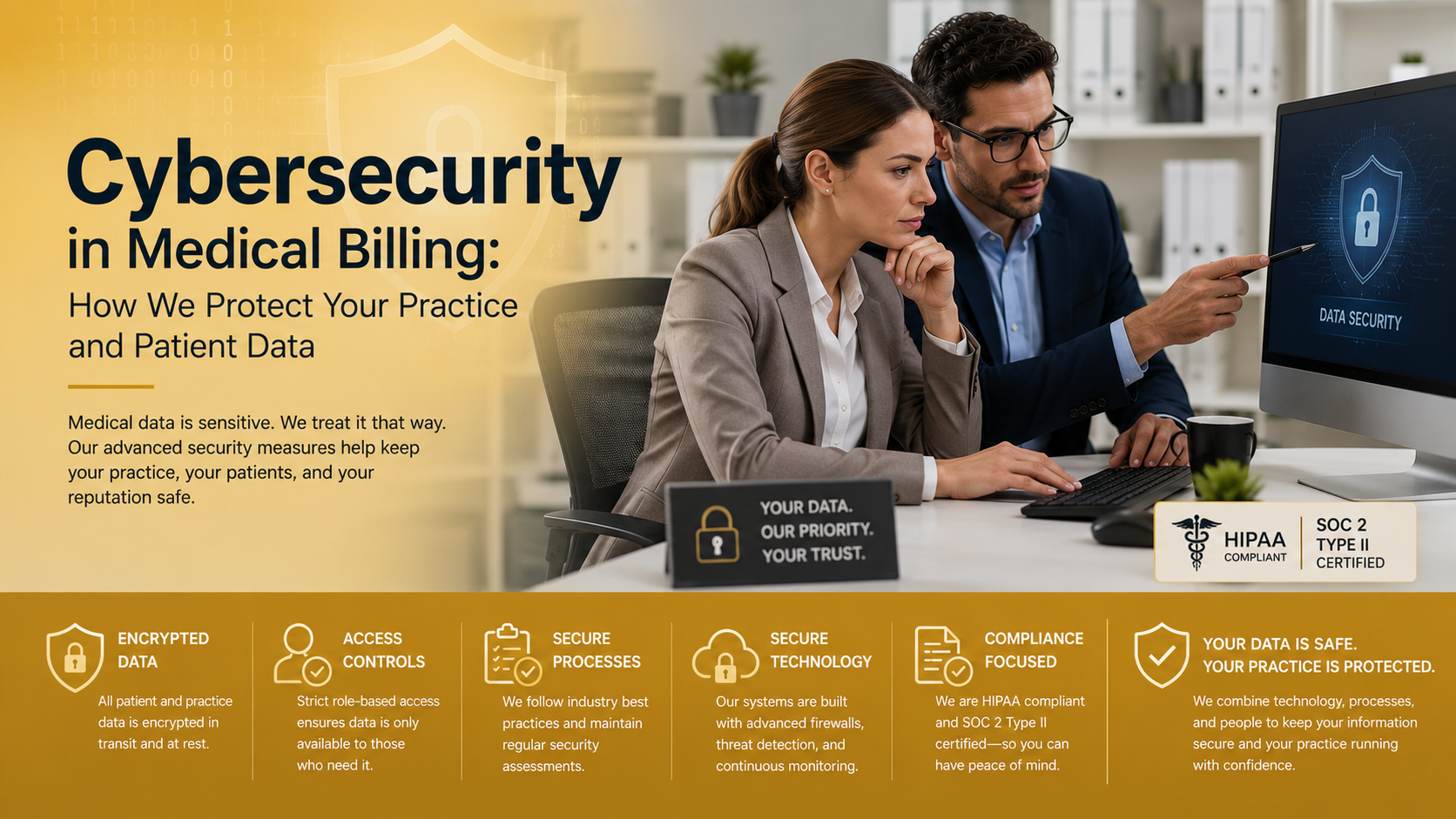
When healthcare leaders discuss practice vulnerabilities, they often focus on clinical malpractice or compliance audits. However, one of the quietest yet most devastating threats facing modern medical practices doesn’t happen in the exam room, it happens on the network server.
Because medical billing involves processing massive amounts of Protected Health Information (PHI) and sensitive financial records, medical billing networks have become a primary target for sophisticated cybercriminals. A single data breach can cost a healthcare facility hundreds of thousands of dollars in regulatory fines, legal fees, and forensic investigations, not to mention the irreparable damage to patient trust.
When you outsource your administrative workflow, you aren’t just looking for speed and accuracy; you are trusting an external partner with your reputation. Here is how advanced cybersecurity protocols protect your practice and your patients.
Why Medical Billing is a Prime Target for Hackers
To a cybercriminal, a medical record is vastly more valuable than a credit card number. A stolen credit card can be canceled in minutes. A medical profile contains a permanent goldmine of data: Social Security numbers, legal names, birth dates, home addresses, and insurance policy details.
Estimated Black Market Value of Stolen Data:
[Single Credit Card Number]  █ $1 – $5
[Complete Medical Record]    ████████████████████ $100 – $250+
This data can be used for identity theft, opening fraudulent lines of credit, or filing fake medical insurance claims. Because the stakes are so high, the federal government enforces strict data privacy laws. Under HIPAA (Health Insurance Portability and Accountability Act), providers are legally responsible for ensuring that their business associates (including billing companies) handle data with ironclad security.
The Three Pillars of Secure Medical Billing
A premium medical billing company treats security as a core operational pillar, utilizing enterprise-level safeguards that are often too costly or complex to maintain within an individual private practice.
1. Advanced Technical Defenses
Your billing data should never travel or sit in a vulnerable format. Secure billing infrastructures rely on two primary technical standards:
- End-to-End Encryption: Data must be fully encrypted both “in transit” (as it moves from your clinic to the billing software) and “at rest” (while stored on servers). If intercepted, encrypted data looks like unreadable gibberish to an attacker.
- Multi-Factor Authentication (MFA): Passwords alone are no longer enough. MFA requires users to provide two or more verification factors to gain access to billing portals, stopping credential-based attacks in their tracks.
2. Strict Access Control and User Monitoring
Not everyone in an organization needs access to every piece of information. The principle of least privilege keeps data compartmentalized.
- Role-Based Access Control (RBAC): Personnel are only granted access to the specific data required to perform their daily tasks. A billing clerk doesn’t need to see a patient’s full clinical narrative, only the codes necessary to process the claim.
- Activity Logs: Automated system logs track exactly who accessed a record, what changes were made, and when the interaction occurred, creating an unalterable audit trail.
3. Continuous Auditing and Employee Training
Human error remains the number one entry point for cyber threats, usually via phishing emails.
- Regular Penetration Testing: Leading billing firms employ third-party security professionals to simulate cyberattacks against their own networks to identify and patch potential vulnerabilities before hackers find them.
- Mandatory Security Training: Billing staff must undergo regular compliance and cybersecurity training to recognize phishing attempts, social engineering, and evolving digital scams.
In-House vs. Outsourced Security: Minimizing Your Risk
Many small to mid-sized practices manage billing in-house, assuming it is safer. However, standard clinic Wi-Fi networks and basic commercial anti-virus software rarely hold up against targeted ransomware campaigns.
By partnering with a dedicated, enterprise-level medical billing service, you effectively transfer the technical burden of data protection to specialists whose infrastructure is specifically built to withstand high-level digital threats.
Total Peace of Mind for Your Practice
Compliance and data security are not optional add-ons; they are the foundation of modern healthcare management. When you choose a billing partner, you should expect total transparency regarding how your data is guarded.
At ProvidaRCM, we don’t just optimize your revenue, we protect it. Our operations are fully HIPAA-compliant, backed by enterprise-grade encryption, routine third-party audits, and strict internal access protocols. We handle the complexities of data defense so you can focus entirely on what matters most: your patients.
Want to learn more about our rigorous security standards? Contact us today to speak with a compliance expert.